The story behind the painting · 3 min read
Young Woman with a Lute
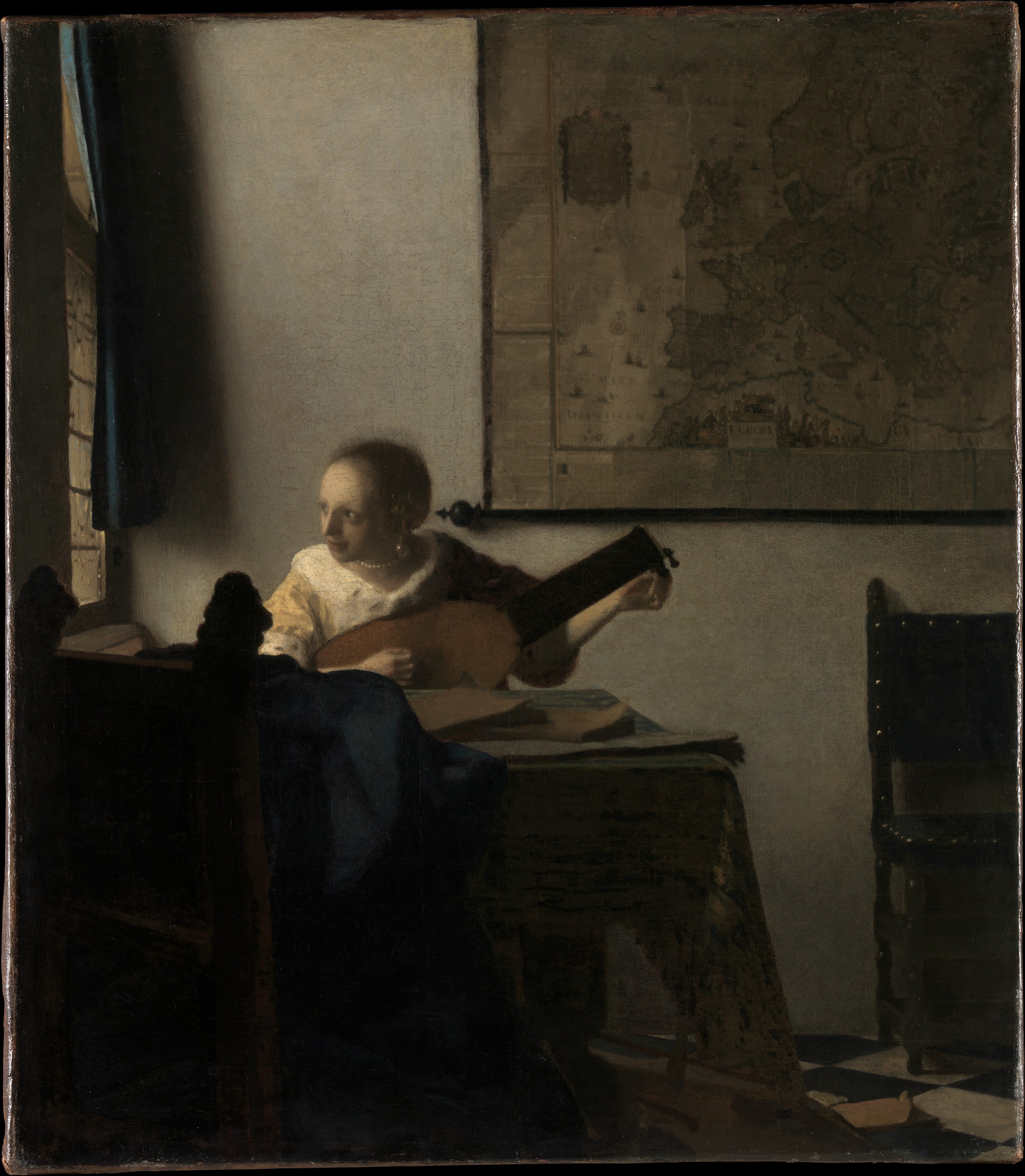
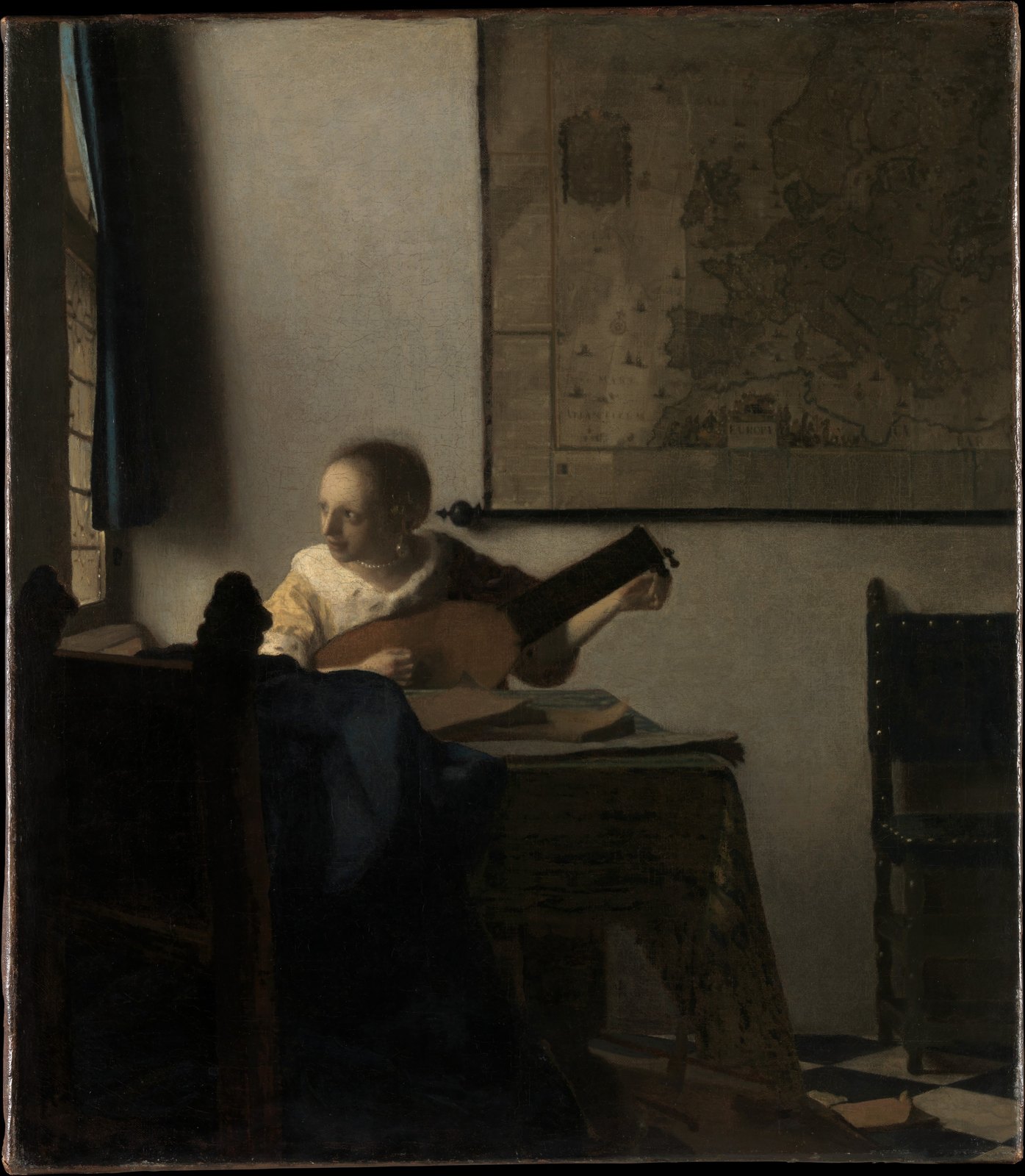
A woman tunes her lute and looks toward the window, while music books and another instrument suggest company to come. Vermeer turns preparations for a duet into a quiet interval of expectation. Painted around 1662–63, the room also connects private leisure with a wider world through its large map of Europe.
The story
The room is full of things, yet it feels hushed. A heavy chair blocks part of the foreground, a table carries papers and an instrument, and a map occupies much of the upper wall. Among these larger shapes, the woman’s face is surprisingly small. Light from the window makes it immediately legible, while the rest of the room settles into brown, gray, and muted gold. Attention concentrates on a moment that contains very little outward action.
The woman is tuning a lute, rather than giving a performance. Open music books and the viola da gamba on the floor suggest a duet. Musical accomplishment formed part of the education of wealthy young people in the Dutch Republic, and playing together could offer an opportunity for courtship. That context makes the room potentially social, although Vermeer leaves the other musician absent. The scene offers evidence of preparation without telling us who will arrive or what relationship will develop.
Her hands point in different directions along the instrument: one is near the strings, the other at the tuning end. Her gaze, however, escapes toward the window. These three directions give the small figure a subtle animation without a broad gesture. The lute’s dark neck crosses the paler wall, making the act of adjustment clearer than it would be against the patterned table covering. A few bright passages in her jacket separate her from the surrounding furniture.
The map of Europe enlarges the room’s horizons. Such maps were fashionable domestic objects in the Netherlands and reflected the importance of navigation and mapmaking. Here its great rectangular shape also steadies the composition above the interrupted shapes below. The image does not require the map to deliver a secret message. Its presence is enough to make the room particular: a place where worldly knowledge, possessions, and cultivated leisure belong together. Vermeer finds his drama in the pause between these stable surroundings and the next small action the woman might take.
A closer look
Details worth noticing.
The tuning hand
Her hand reaches along the dark neck of the lute toward its pegs. The gesture identifies preparation rather than performance, giving the scene its suspended, expectant quality.
The map of Europe
Maps decorated prosperous Dutch homes and reflected a culture invested in navigation and cartography. This one also provides a large, steady rectangle above the smaller interruptions of furniture and music.
The window light
Light picks out the woman’s face and yellow jacket while leaving the foreground chair dark. That uneven illumination lets a small figure hold attention inside a room dominated by objects.
Sources & image credits
Explore the museum’s research and collection record.
Bequest of Collis P. Huntington, 1900 · CC0 · Original museum image