The story behind the painting · 3 min read
The Child's Bath
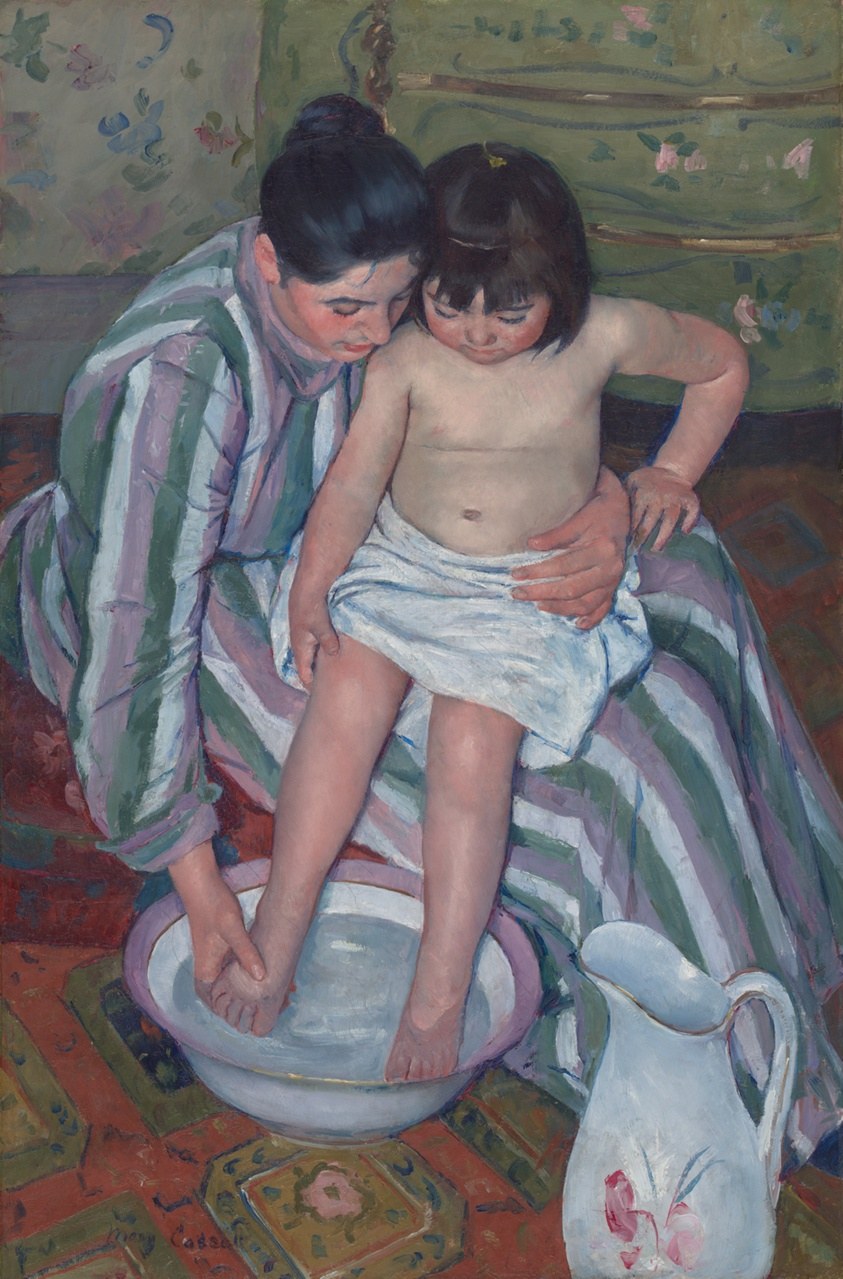
Mary Cassatt gives a routine act of care the concentration of a major event. Looking steeply down into the scene, we follow two lowered faces toward a child's feet in a basin. Stripes, flowers, and carpet patterns surround the bodies, revealing Cassatt's engagement with Japanese art in the 1890s.
The story
The woman and child look down together. Their heads almost touch, and the woman's arm wraps around the child's middle while her other hand attends to a foot. The action is ordinary and specific. Cassatt does not need an embrace, a smile toward the viewer, or a dramatic incident to make their physical closeness the center of the painting.
Her viewpoint is crucial. We see the tops of the heads and look into the basin from above. The floor seems to rise behind and beneath the figures instead of receding into a deep room. This steep angle places us close to the action while denying the comfortable distance of a conventional view across an interior. The space is organized around the bodies and the work being done.
This approach reflects Cassatt's intense interest in Japanese aesthetics during the 1890s. Pattern is not merely decoration applied to solid objects. The stripes of the dress, the carpet's colored compartments, and the scattered flowers behind the figures compete for attention across the canvas. They keep bringing our eyes back to its surface, even as the rounded arms and legs establish a convincing bodily presence.
Look at the child's hand resting against the woman's knee. It provides a small point of balance that answers the supporting hand around the waist. The white cloth across the lap interrupts the surrounding stripes, making the child's torso especially clear. Below, the circular basin gathers the narrow downward movement of the legs into a broad oval. The pitcher beside it echoes the pale cloth and skin without taking over the scene.
The painting was exhibited widely from 1893 and entered the Art Institute in 1910, the museum's first work by Cassatt. Its lasting force lies partly in that combination of intimacy and formal invention. Care appears as a series of coordinated gestures: holding, leaning, steadying, and washing. Cassatt makes those gestures worth sustained attention while giving the surrounding patterns enough independence to turn a familiar domestic subject into a strikingly constructed picture.
A closer look
Details worth noticing.
A steadying hand
The child presses one hand against the woman’s knee while the woman supports the waist. These separate points of contact make balance and bodily trust visible without an exchanged glance.
The rising floor
The carpet occupies a large, steeply tilted area rather than disappearing into distant space. Its pattern makes the floor seem close to the picture’s surface and intensifies the intimate viewpoint.
Stripes around the body
The dress’s stripes bend around arms and knees but remain strong bands of color. They describe the woman’s form while also joining the surrounding carpet and wallpaper as pattern.
Sources & image credits
Explore the museum’s research and collection record.
- Art Institute of Chicago: collection record ↗
- Art Institute of Chicago: museum catalogue and open-access record ↗
Robert A. Waller Fund · CC0 · Original museum image