The story behind the painting · 3 min read
Terrace and Observation Deck at the Moulin de Blute-Fin, Montmartre
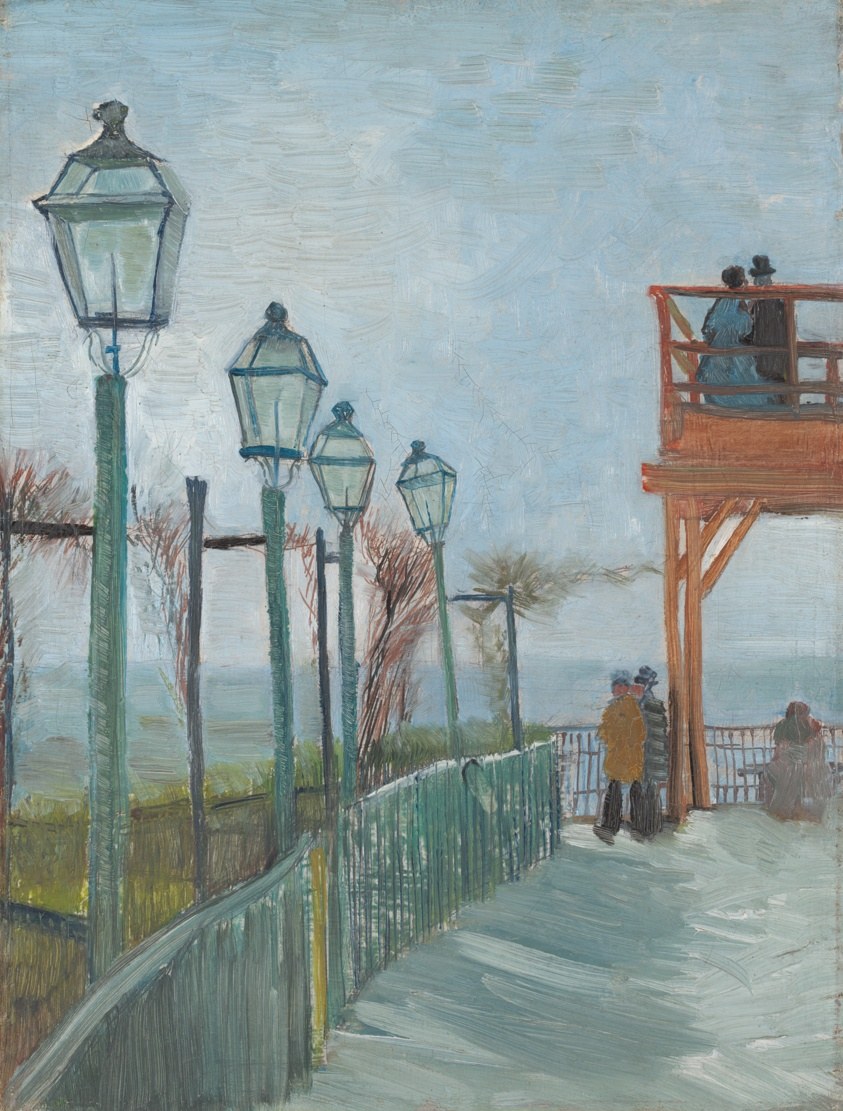
Before the bright rooms and orchards of southern France, Van Gogh painted the changing landscape around his Paris home. This Montmartre terrace belonged to a former windmill turned tourist attraction. Its tall lamps and observation platform show a rural landmark being adapted to the leisure of the expanding city.
The story
Four lamps recede along a railing, their oversized glass heads standing sharply against the pale sky. A wooden platform enters from the right, carrying two small spectators above the terrace. Other visitors gather below. Van Gogh gives the structures more visual weight than the people, so the place itself becomes the painting's principal character.
He made the work in the winter of 1887, about a year after arriving in Paris to live with his brother Theo. The hill of Montmartre was within easy reach of their apartment on the rue Lepic. Its landscape still contained kitchen gardens, disused quarries, and surviving windmills, traces of a rural past increasingly surrounded by the city. These were nearby subjects through which Van Gogh could study a place in transition.
The Moulin de Blute-Fin no longer functioned as a working mill. It had become an attraction, with an observation tower offering a panorama over Paris. The painting is therefore about a place designed for looking, yet it withholds the expansive view that brought visitors there. Instead, we encounter the apparatus of sightseeing: the platform, the railing, the lamps, and the people positioned to gaze outward.
The nearest lamp is much larger than those behind it. That rapid change in scale pulls the eye down the terrace, while the converging railing supplies a second route into depth. Bare branches make thin reddish interruptions between the green posts. The platform's orange-brown timber cuts across the cool blues and greens, giving the right side a firm counterweight to the procession of lamps on the left.
The brushwork remains visible throughout. Broad strokes sweep across the ground, and the sky is built from pale, overlapping passages rather than a seamless wash. The distant city barely asserts itself. What stays in memory is the odd intimacy of a public lookout in winter: a few bundled figures, a row of lights, and an elevated structure poised above an open view. The landscape records modern leisure through the ordinary things that make it possible.
A closer look
Details worth noticing.
A working mill transformed
The Moulin de Blute-Fin had stopped working and become a tourist attraction. The raised viewing structure belonged to that new role, offering visitors a panorama over the city.
Four lamps, one recession
The lamps shrink quickly as they move away from the foreground. Their repetition creates a clear sense of distance even though the pale landscape beyond is only loosely described.
Visitors above and below
The platform separates two pairs of spectators vertically. Their small scale emphasizes the built structure, while their outward orientation directs attention toward a panorama the painting largely keeps beyond view.
Sources & image credits
Explore the museum’s research and collection record.
- Art Institute of Chicago: collection record ↗
- Art Institute of Chicago: museum catalogue and open-access record ↗
Helen Birch Bartlett Memorial Collection · CC0 · Original museum image