The story behind the painting · 3 min read
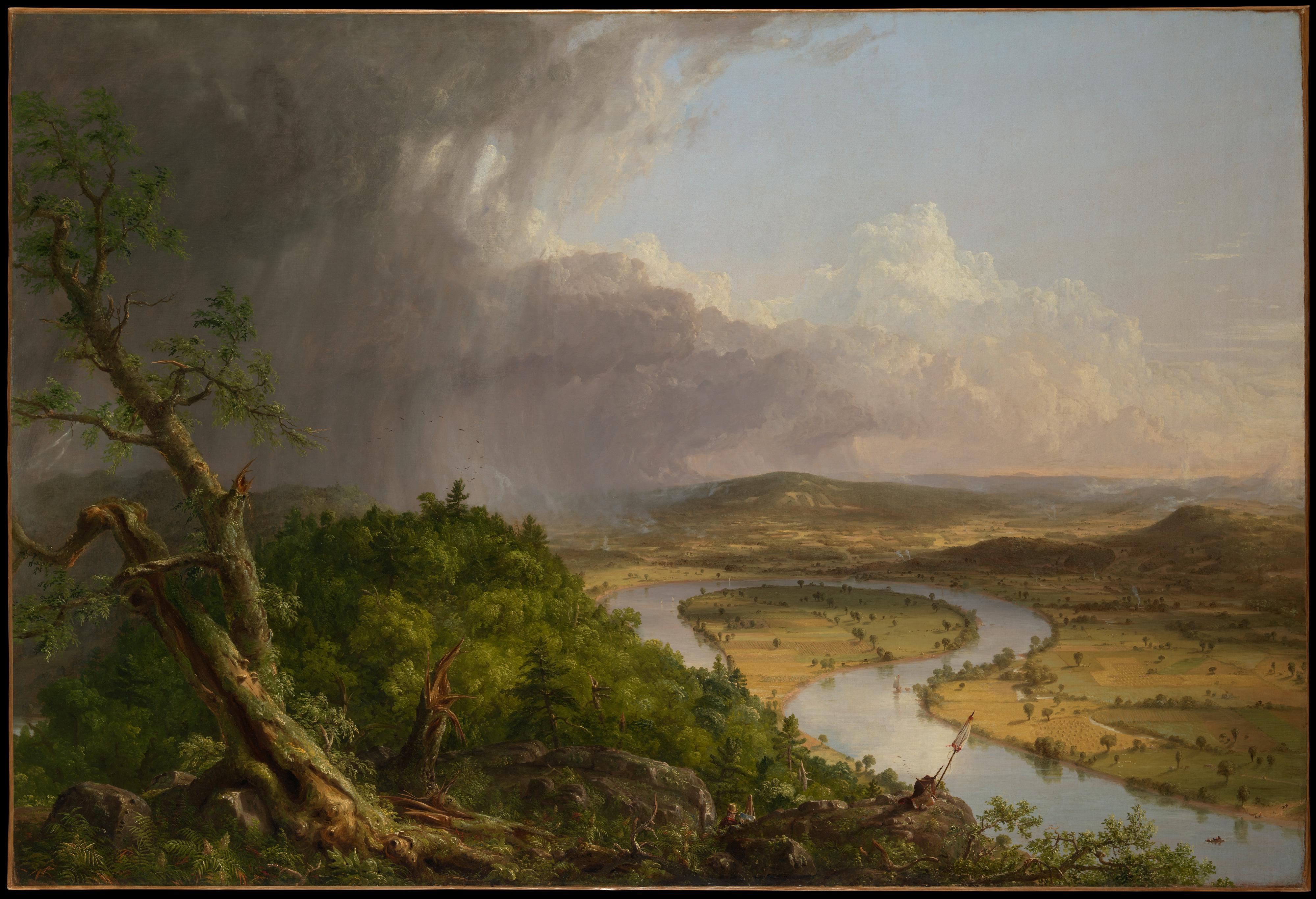
View from Mount Holyoke, Northampton, Massachusetts, after a Thunderstorm—The Oxbow
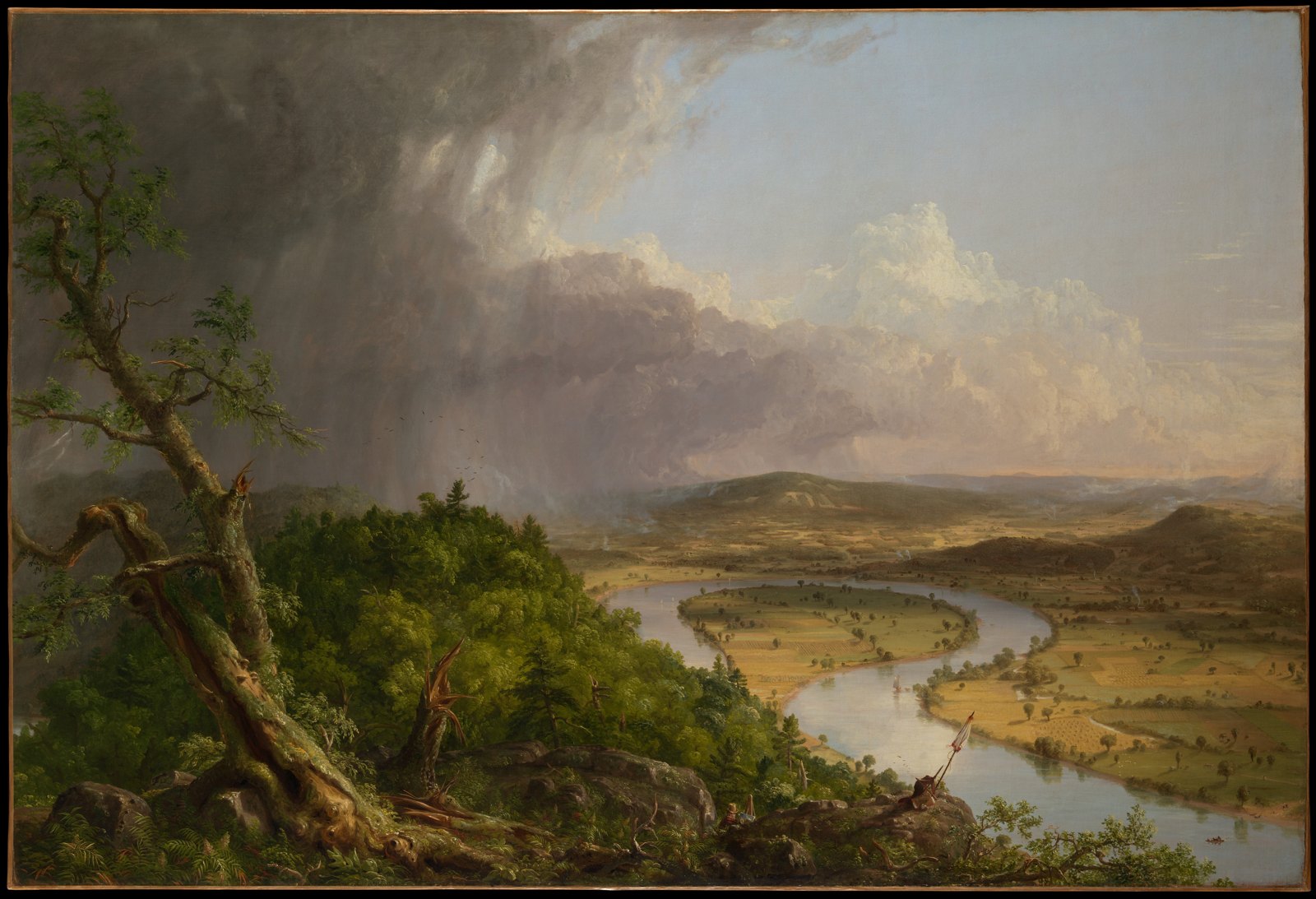
Thomas Cole’s view from Mount Holyoke places storm-darkened woodland beside the sunlit farms of the Connecticut River valley. Painted in 1836, it makes settlement and land use part of the landscape’s meaning. A tiny self-portrait near the foreground reminds us that this sweeping view is also a deliberately constructed picture.
The story
A broken tree leans against the sky at the left, while a great loop of river shines at the right. Between them, the painting changes weather, texture, and scale. Dark foliage fills the near slope; beyond it, fields become small, orderly parcels. Cole does not merely show a beautiful prospect. He makes the distance between rough woodland and cultivated land feel like a comparison the viewer must consider.
The place is the Connecticut River valley seen from Mount Holyoke in Massachusetts, and the broad bend gives the painting its familiar name, The Oxbow. Cole painted the work in 1836. Its division between wooded foreground and agricultural distance brings Euro-American settlement into the subject. The landscape should not be understood as an empty wilderness simply waiting for cultivation: the picture’s apparent contrast between nature and improvement belongs to a history of occupation, land use, and displacement.
The weather sharpens that contrast without keeping the halves completely separate. A gray curtain of rain lies over the distant land, while blue opens above the right side. The river catches the brighter sky and becomes one of the most conspicuous shapes in the picture. Its curve is soft and continuous, unlike the angular trunk in front. Both forms bend, but one carries the eye through a wide, inhabitable valley and the other marks the damage of a forceful encounter with weather.
Cole includes himself as a tiny painter near the lower center, pausing at his work. Once noticed, he changes the scale of everything around him. Leaves and rocks that initially seem close become part of an enormous setting in which a person occupies very little space. He also interrupts the illusion that the panorama has simply presented itself. Someone has selected this viewpoint, arranged these oppositions, and made the image. The small figure is a useful reminder that a landscape painting records an attitude toward a place as well as its visible features.
A closer look
Details worth noticing.
The small painter
Cole places himself near the lower center, looking out from his work. The tiny figure supplies scale and acknowledges the person who selected and constructed this sweeping landscape.
The river bend
The bright loop of the Connecticut River gives the painting its familiar name. Its smooth curve holds together the many small divisions of farmland spread across the valley.
The broken tree
The jagged trunk interrupts the left sky with a hard silhouette. Its damaged shape contrasts with the soft river curve, making the foreground feel exposed to powerful weather.
Sources & image credits
Explore the museum’s research and collection record.
Gift of Mrs. Russell Sage, 1908 · CC0 · Original museum image