The story behind the painting · 3 min read
Twilight in the Wilderness
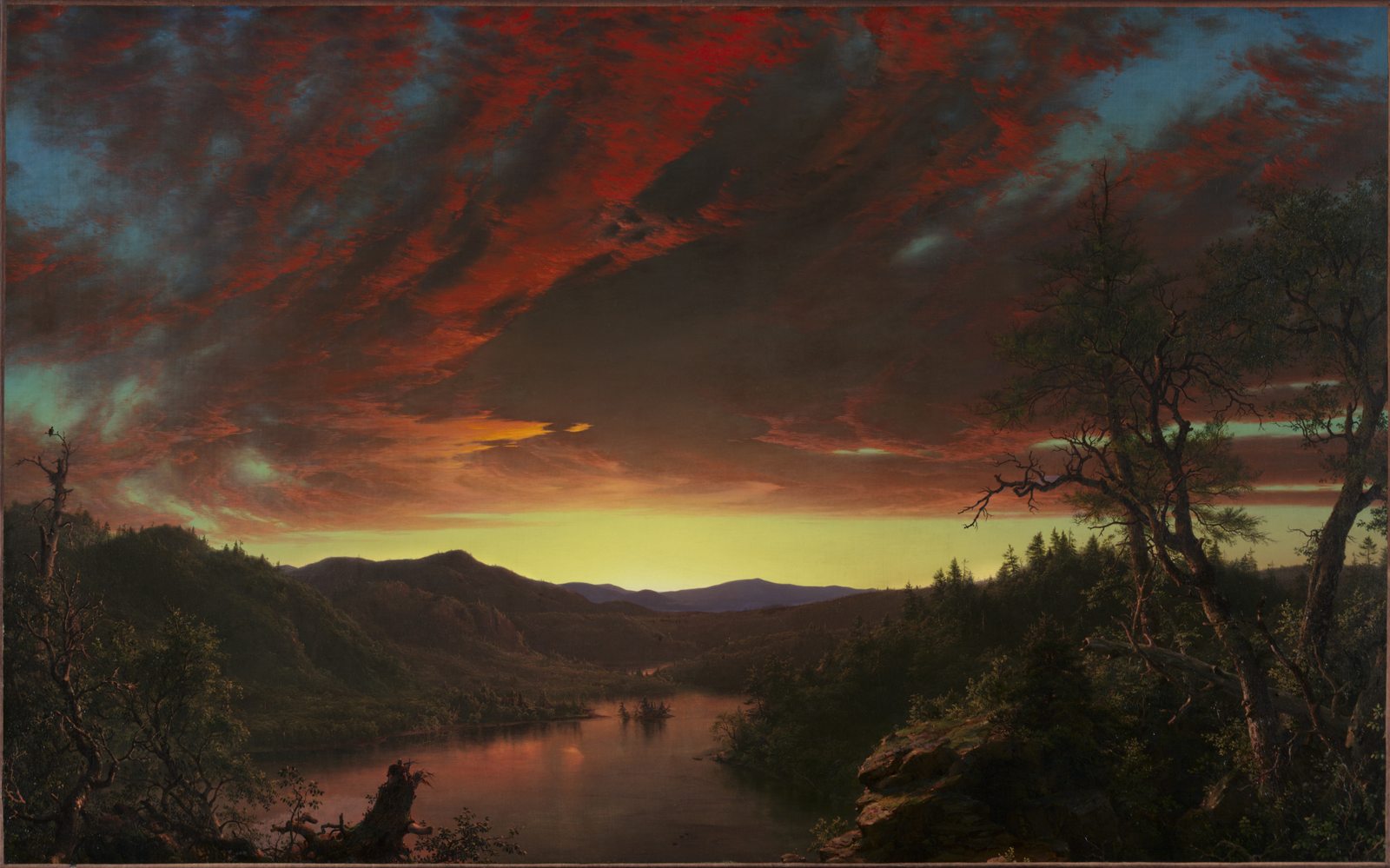
Frederic Edwin Church built this blazing Maine sunset from sketches made nearly two years earlier. Painted in his New York studio in 1860, the landscape became a public event when he exhibited it alone. Its fiery sky can also suggest the country's approaching Civil War, although that reading remains an interpretation rather than a recorded explanation.
The story
The brightest light is a narrow opening above the mountains. Around it, dark clouds sweep upward in red and orange bands, taking up far more space than the land beneath. The river catches that color and carries it toward the foreground. Church makes a sunset feel enormous by giving it both an expansive sky and a second, quieter presence in the water.
The landscape originated in sketches Church made near Mount Katahdin in Maine almost two years before completing the painting in his New York studio. That interval matters. This is a carefully constructed canvas based on observation, not an outdoor picture made while a particular sunset lasted. The intricate foreground and the broad aerial effects belong to a single deliberate arrangement, even though they invite the feeling of a moment witnessed in nature.
Trees frame the view without forming a perfectly balanced pair. At the right, bare branches write thin, irregular lines across the sky; darker masses at the left settle into the slope. The nearest ground gives the eye rough surfaces and tangled shapes before the distance opens. That shift in scale makes the landscape feel traversable, but the lack of a dominant human figure keeps the atmosphere from becoming a backdrop to someone's adventure.
Completed in 1860, on the eve of the American Civil War, the painting can be read as an image of approaching national conflict. Its burning colors support that possibility, but the sky should not be treated as an unambiguous coded message. A sunset can be beautiful, threatening, and transient at once. The work's power lies partly in allowing those responses to coexist, rather than directing us toward only one historical meaning.
Church also understood how to present a painting to the public. He exhibited this canvas on its own, and publicity and favorable reviews drew hundreds of visitors over seven weeks. The arrangement asked people to devote sustained attention to one landscape. The picture rewards that concentration: distant mountains first appear as a simple silhouette, then divide into layers; the dark valley acquires depth; the bright clouds become a complex pattern of edges, gaps, and fading light.
A closer look
Details worth noticing.
The red clouds
The clouds combine fiery color with dark undersides. Their irregular bands make the sky feel active, while the thin yellow horizon supplies a relatively still point beneath them.
The reflected sky
The river repeats the sky’s reds at a smaller scale and lower intensity. That echo connects the immense atmosphere to the enclosed valley instead of separating sky and ground.
The distant mountains
The view grew from Church’s sketches near Mount Katahdin in Maine. He developed the finished canvas later in New York, combining remembered experience with deliberate studio construction and detail.
Sources & image credits
Explore the museum’s research and collection record.
Mr. and Mrs. William H. Marlatt Fund · CC0 · Original museum image