The story behind the painting · 3 min read
The Red Kerchief
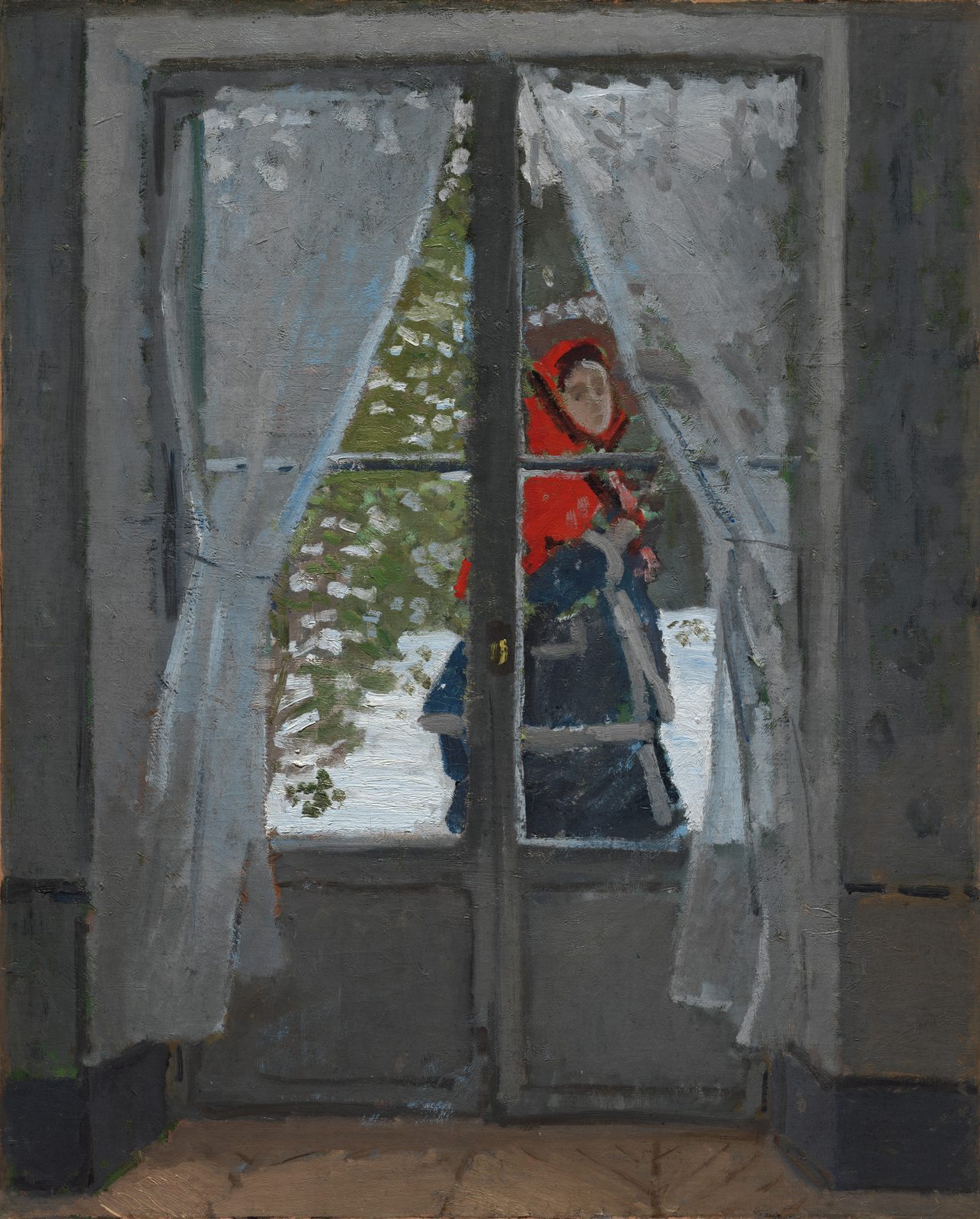
Camille Monet appears outside a pair of glass doors, her red clothing vivid against the snow. Monet makes the architecture and curtains part of the encounter, separating the warm interior viewpoint from the winter scene. The quick marks that form her face preserve a fleeting glance in a painting he kept throughout his life.
The story
Much of this portrait consists of a door. Its gray uprights, crossbars, and pale curtains occupy the foreground, while the woman herself stands outside. Monet gives a domestic barrier unusual prominence. The result feels less like a formal sitting than an interruption in ordinary life: a familiar person has passed the window and turned toward the room.
The woman is Monet's first wife, Camille, shown at their home in Argenteuil. Her red kerchief and cape provide the strongest color in a scene of white snow, gray woodwork, and subdued green foliage. The precise date remains uncertain, given as about 1868–73. That uncertainty should remain part of the painting's history; the apparent immediacy of the image does not allow us to assign it to a particular day or winter.
The curtains have a double role. They veil the view with pale patterns, but their pulled-back edges also create a narrow opening around Camille. White is therefore present in very different forms: indoor fabric, lace-like decoration, and outdoor snow. Monet distinguishes them through placement and touch rather than by describing every fold or snow-covered branch. The cool light makes the interior and exterior share a palette even as the glass keeps them apart.
Camille's face is assembled from a small number of visible marks. Its abbreviated treatment belongs to the same pictorial language as the broken patches of foliage behind her. A portrait normally promises sustained scrutiny, yet Monet lets recognition happen with very little information. The surrounding structure strengthens that effect. Because the door is so emphatically still, the figure beyond it seems capable of moving out of view at any moment.
Monet kept the painting for the rest of his life. That fact lends weight to its intimate scale of attention without telling us exactly what memories he attached to it. The scene's emotional force does not depend on inventing them. The red fabric, interrupted outline, and briefly visible face already offer a precise form of closeness: someone known, seen across a small distance, within the everyday architecture of a shared home.
A closer look
Details worth noticing.
Camille’s face
A few separate marks establish Camille’s face without smoothing away their painted character. Recognition arrives through color and placement, matching the fleeting quality of her appearance outside the door.
The white curtains
The curtains share the snow’s pale color but remain legible as indoor fabric. Their falling edges create an opening around Camille while keeping the room’s boundary visible.
The red clothing
Camille’s red kerchief and cape pull her forward against the cool winter setting. The concentrated color makes the small visible portion of her figure dominate the much larger doorway.
Sources & image credits
Explore the museum’s research and collection record.
Bequest of Leonard C. Hanna Jr. · CC0 · Original museum image