The story behind the painting · 3 min read
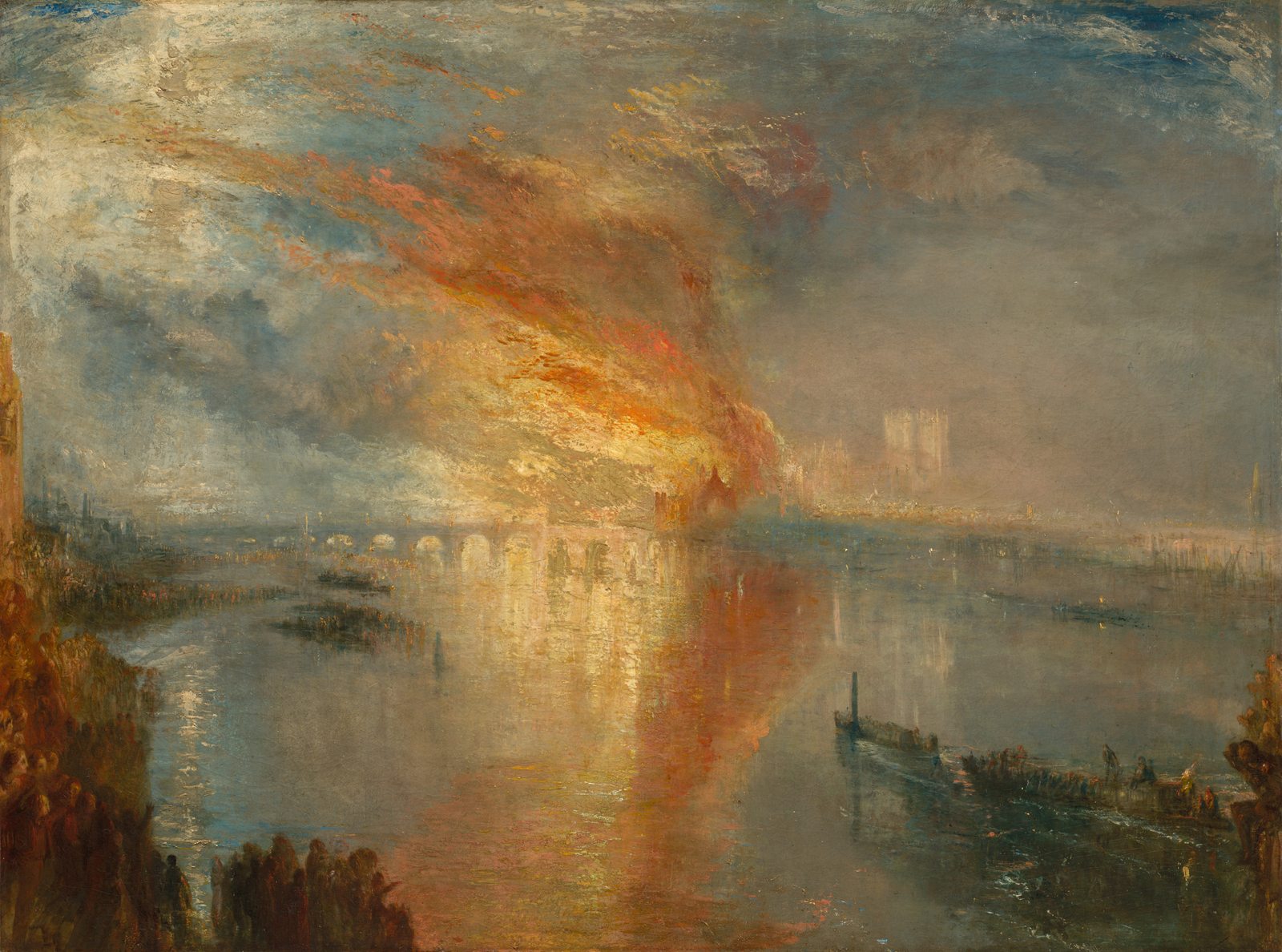
The Burning of the Houses of Lords and Commons, 16 October 1834
The Houses of Parliament burned on 16 October 1834 as crowds watched from the Thames. Turner transformed the disaster into a vast encounter between fire, water, and human effort. His enlarged flames dominate the scene, while boats heading toward the blaze preserve a reminder of the difficult practical work taking place beneath the spectacle.
The story
Fire rises beyond the river in a long, sweeping mass, then appears again as a broken reflection. The two areas of hot color nearly meet at the waterline. Around them, sky and river dissolve into pale blue, gray, and gold. Turner allows the recognizable city to lose much of its solidity, making light and smoke seem more substantial than the buildings themselves.
The subject was an actual disaster: the burning of London's Houses of Parliament on 16 October 1834. People gathered beside the Thames to watch. Low tide initially obstructed efforts to pump water and complicated the movement of steamers carrying firefighting equipment. The blaze continued for hours. Turner completed this painting the following year, converting the event into a composition whose visual scale goes far beyond a straightforward record of damaged architecture.
He exaggerated the height of the flames. That choice changes the relation between people and their environment. Boats in the lower right head toward a force that appears almost impossibly large, while spectators along the bank become a dark, irregular fringe. Individual figures are hard to separate at first. They register collectively, as a human presence facing something that no single body in the picture could hope to control.
The bridge and riverside buildings provide fragments of order within that instability. Their pale horizontal forms resist the rising sweep of the fire, but their edges are softened by atmosphere. Reflections stretch them into the water rather than anchoring them firmly. The painting holds us between recognition and dissolution: a place can still be identified, yet the materials through which we see it seem to be breaking apart in heat and light.
Turner painted another version from a different viewpoint; this one looks downriver from the southeast bank. The particular position matters less, visually, than the broad expanse of water it opens between us and the blaze. That distance creates room for the fire's reflection and exposes the small scale of the approaching boats. The river becomes both an obstacle to emergency work and the surface that multiplies the disaster's extraordinary brightness.
A closer look
Details worth noticing.
The approaching boats
The boats at lower right head toward the blaze. Low tide initially hindered firefighting on the Thames, making this small passage a reminder of practical struggle beneath the enormous spectacle.
The towering flames
Turner enlarged the flames beyond the event’s literal appearance. Their height makes buildings and people seem fragile, shifting the picture from topographical record toward an experience of overwhelming force.
Fire in the water
The reflection extends the blaze downward in broken vertical strokes. It gives the fire a second field of color, so the disaster occupies the river as well as the sky.
Sources & image credits
Explore the museum’s research and collection record.
Bequest of John L. Severance · CC0 · Original museum image