The story behind the painting · 3 min read
Fight Between a Tiger and a Buffalo
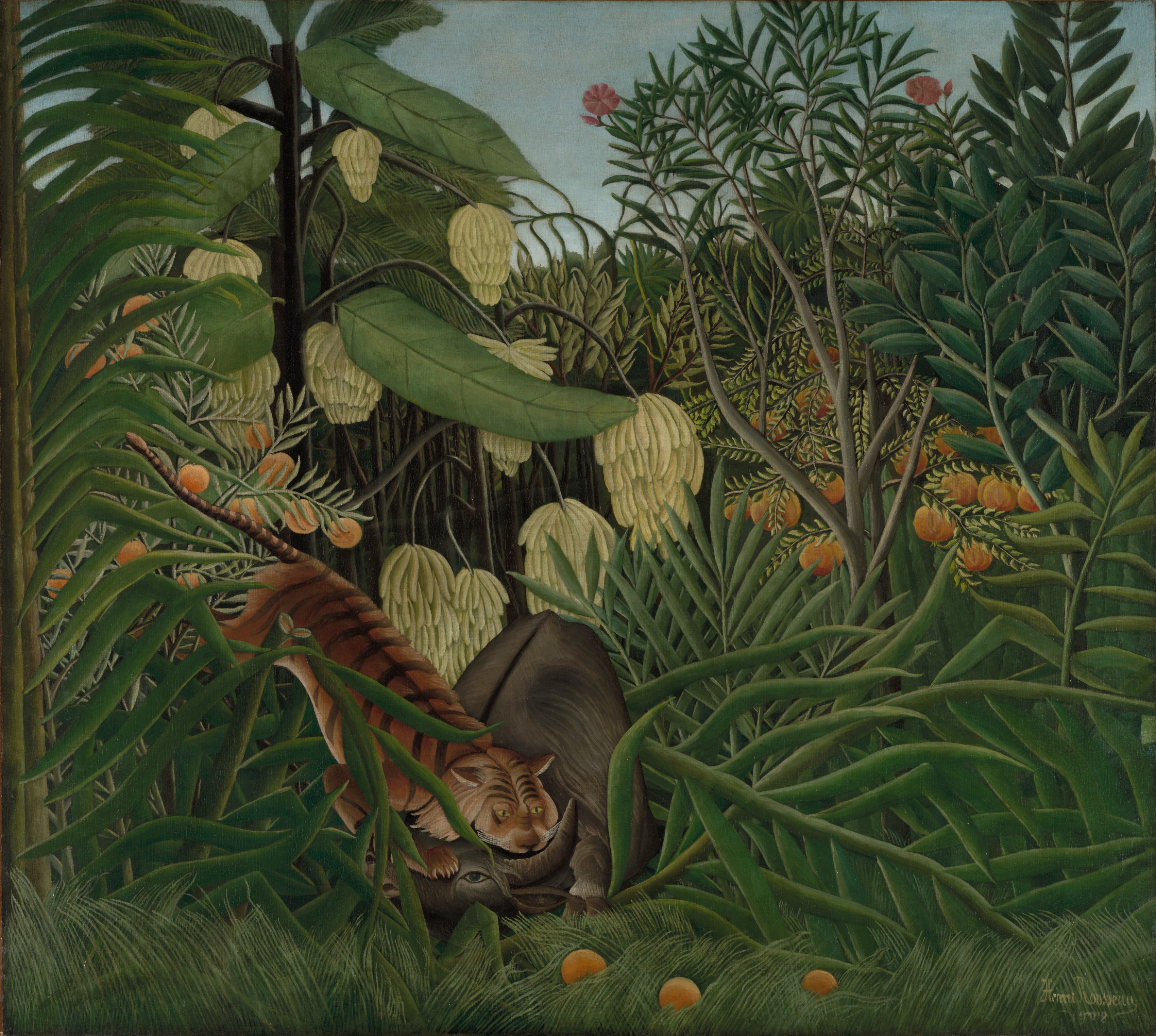
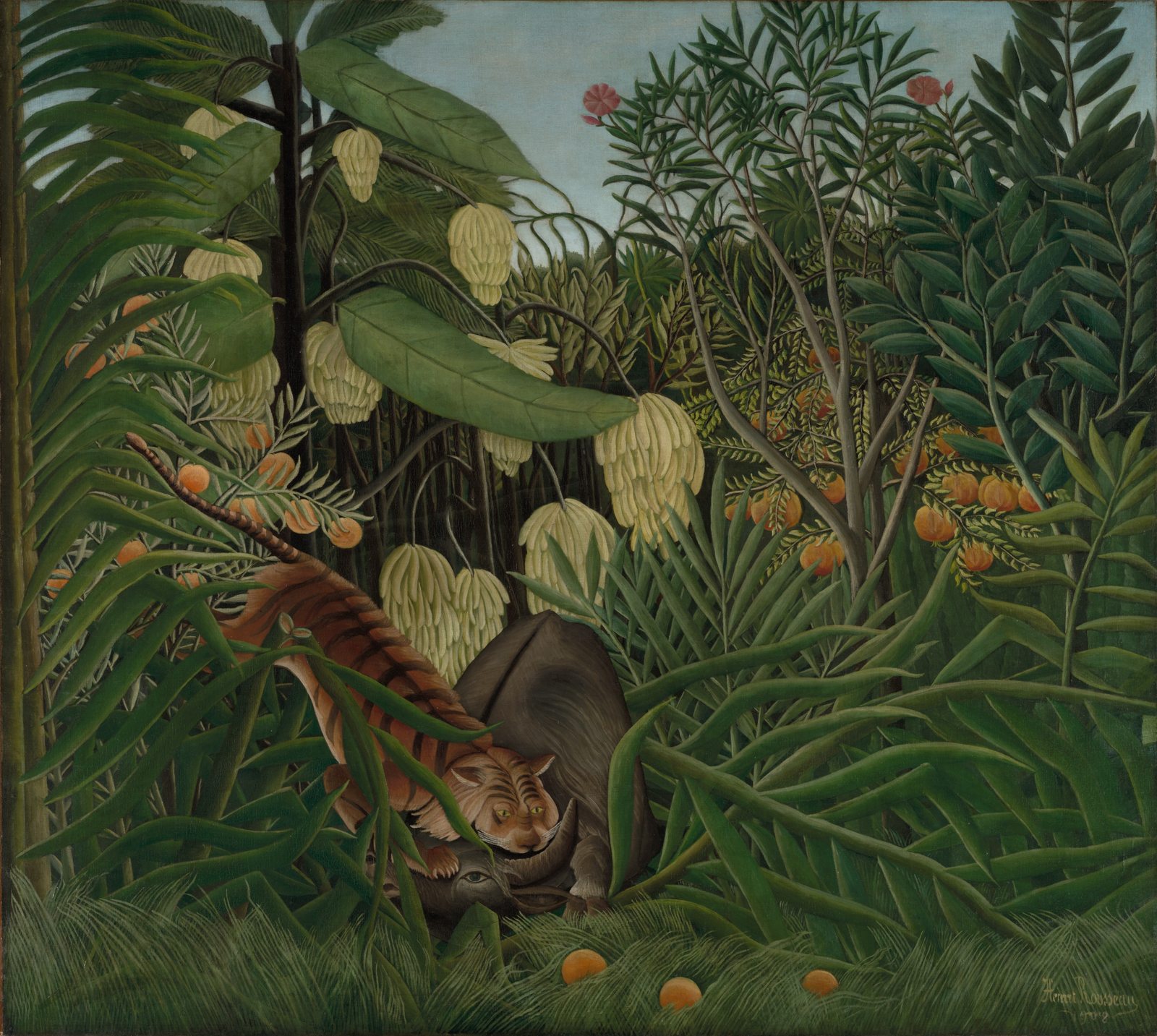
Henri Rousseau never traveled beyond France, yet he built jungle paintings from botanical gardens, books, and invention. Here, enormous leaves almost swallow a violent struggle between two animals. The sharply drawn plants and improbable bananas reveal an imagined environment, where patterned abundance and sudden danger occupy the same tightly organized space.
The story
The jungle appears to have no empty space. Leaves overlap leaves, fruit hangs between stems, and long green blades press across the animals at the bottom. The tiger's stripes almost become another plant pattern. Only gradually does the central violence separate itself from this elaborate surface: the tiger has caught the buffalo, whose dark body bends beneath the attack.
Rousseau assembled such environments without leaving France. Travel books and visits to the botanical garden in Paris supplied material that he reshaped into imagined tropical scenes. This painting does not claim the accuracy of a scientific illustration. Plants expand to improbable scale, and the bananas hang in an unnatural arrangement. These departures belong to a setting made from selection and invention rather than direct experience of a jungle.
The leaves are remarkably distinct. Each has a clear outline, with veins or parallel strokes making its structure readable. Yet their accumulation does not produce an easy path into the distance. Instead, the layers repeatedly block one another. The narrow strip of sky at the top offers little release. Rousseau creates a place that feels abundant and enclosing at once, with the same careful clarity applied to a flower, a fruit, and the animals' confrontation.
The painting was exhibited at the Salon des Indépendants in March 1908. Rousseau was self-taught and had worked as a customs inspector; younger artists, including Picasso, admired the independence of his approach. What might seem awkward under academic expectations becomes a source of strength here. The flattened arrangement and emphatic contours allow decorative order to coexist with an action that is anything but peaceful.
The buffalo's eye faces outward while much of its body disappears among foliage. That small point of visibility makes the struggle suddenly immediate. Around it, the leaves remain undisturbed in their repeated shapes. The contrast is more unsettling than a scene filled entirely with movement would be: violence takes place within a world that continues to look meticulously arranged. Rousseau's invention is not simply an escape into lush scenery. It makes beauty and threat difficult to disentangle.
A closer look
Details worth noticing.
The hanging bananas
The bananas grow in an improbable direction, revealing the scene’s invented botany. Rousseau combined garden observations and books into an imagined environment rather than documenting a real tropical location.
The buffalo’s eye
The buffalo’s visible eye faces outward while foliage conceals much of its body. That tiny clear detail makes the struggle immediate within a surface otherwise dominated by repeated plant shapes.
The tiger’s stripes
The tiger’s dark stripes resemble the parallel markings on surrounding leaves. Animal and vegetation briefly share a visual pattern, making the violent action emerge from the jungle rather than stand apart.
Sources & image credits
Explore the museum’s research and collection record.
Gift of the Hanna Fund · CC0 · Original museum image