The story behind the painting · 3 min read
The Millinery Shop
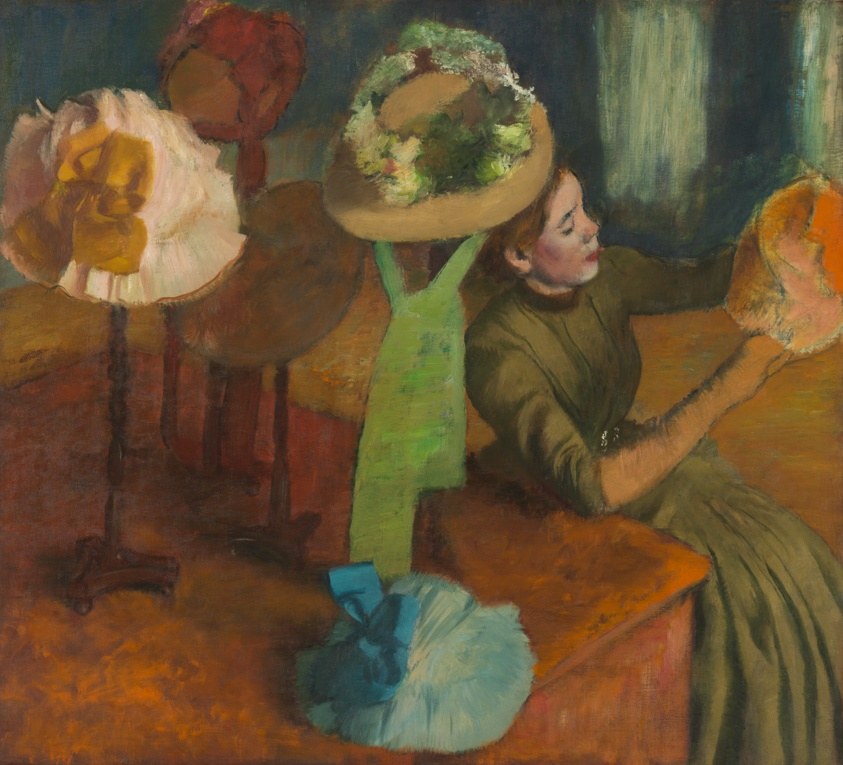
A woman examines a hat in a shop, but Degas leaves her social position uncertain. Her elegant clothes could belong to a customer or a skilled employee. Around her, hats become large arrangements of color, and one appears almost to sit on her head despite being displayed on a stand.
The story
The hats arrive before the person. Pale fabric, yellow ribbon, green trimming, and blue decoration spread across the foreground and upper left, while the woman occupies the right side behind the counter. She is absorbed in a hat held between her hands. Degas makes the merchandise visually assertive enough to compete with the human figure rather than serve as a decorative background.
This is his largest painting devoted to milliners, the makers and sellers of hats. Its apparently casual view was carefully prepared through drawings and pastels of the woman. Degas adjusted her pose and clothing as he worked toward the final composition. The image therefore joins an intimate observation of labor or shopping to an unusually deliberate arrangement of bodies, objects, and empty intervals.
The woman's role is not entirely secure. Her fashionable green dress and long gloves could fit either an affluent customer or an employee. Millinery demanded taste and skill, offering successful young women a degree of professional standing. Yet a wealthy visitor would normally have worn her own hat, and this woman is bareheaded. Degas holds those conflicting signals together instead of giving us an unmistakable costume for a single social type.
He also makes a visual joke out of that uncertainty. A hat with green decoration is positioned so close to her head that it briefly seems to be hers. Looking again separates the display from the woman. The long green ribbons descend between them, bridging the gap. At the front, a blue-trimmed hat rests low against the warm counter, creating a different sort of proximity: its soft, pale surface seems almost within reach.
The painting rewards attention to the spaces between things. Narrow supports hold up the hats on the left, while the woman's diagonal arms lead toward the object she examines. Large areas of ocher counter keep these elements from dissolving into clutter. Degas turns a shop into a study of looking, choosing, and making, while allowing the boundaries between purchaser and professional to remain unresolved. Fashion becomes both a material pleasure and a complicated language of social identity.
A closer look
Details worth noticing.
A hat that almost fits
The green-trimmed display hat overlaps the space beside the woman’s head. For a moment it appears to be worn, a visual ambiguity that mirrors uncertainty about her role in the shop.
Customer or employee
Her elegant gloves and dress do not settle her identity. The museum notes that both prosperous clients and skilled millinery workers could wear such clothes, while her bare head complicates matters.
Blue against the counter
The pale hat with blue trim rests near the front edge. Its cool colors stand out against the warm counter, bringing one soft, elaborate object unusually close to the viewer.
Sources & image credits
Explore the museum’s research and collection record.
- Art Institute of Chicago: collection record ↗
- Art Institute of Chicago: museum catalogue and open-access record ↗
Mr. and Mrs. Lewis Larned Coburn Memorial Collection · CC0 · Original museum image