The story behind the painting · 3 min read
Portrait of a Woman with a Man at a Casement
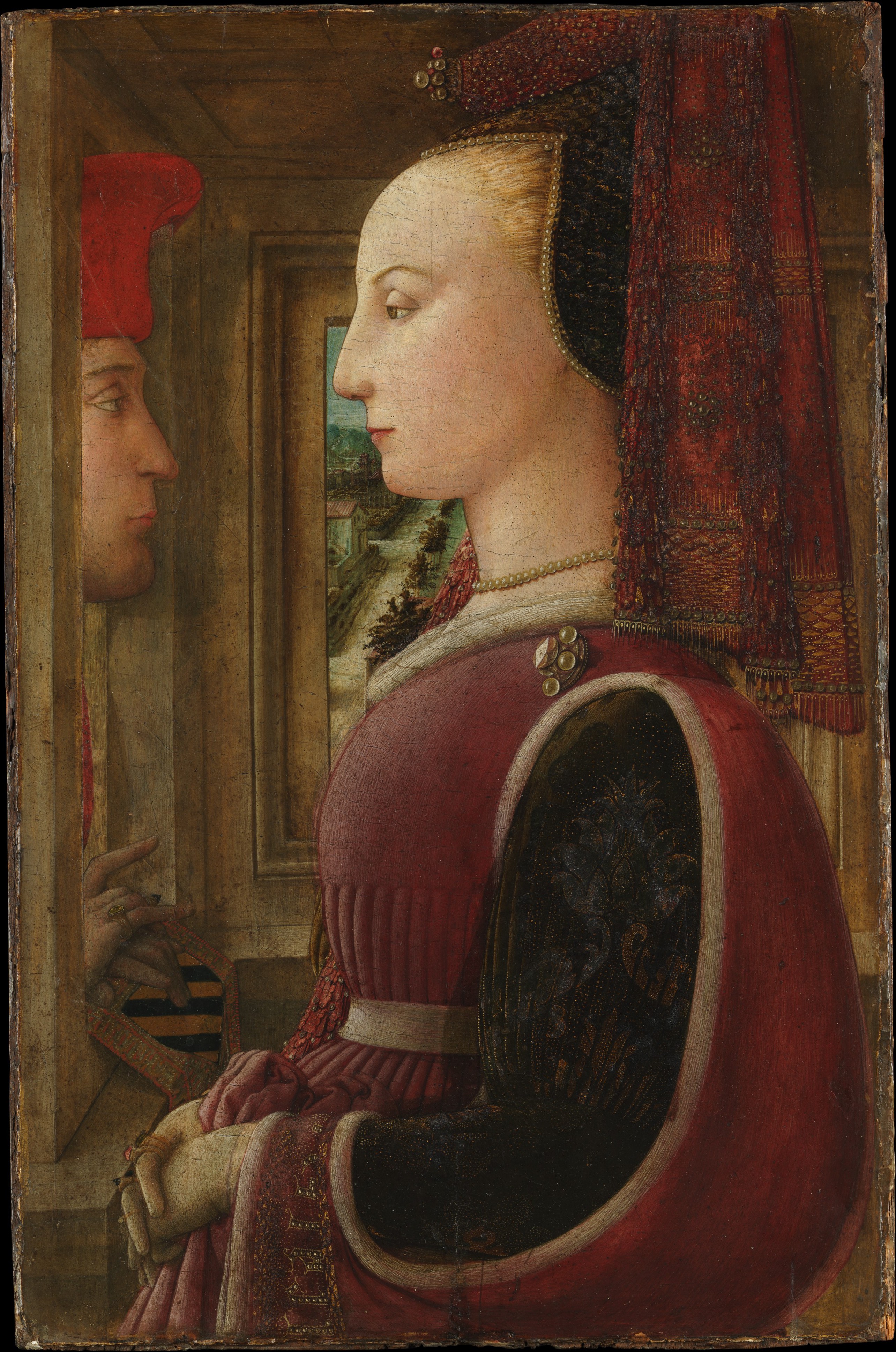
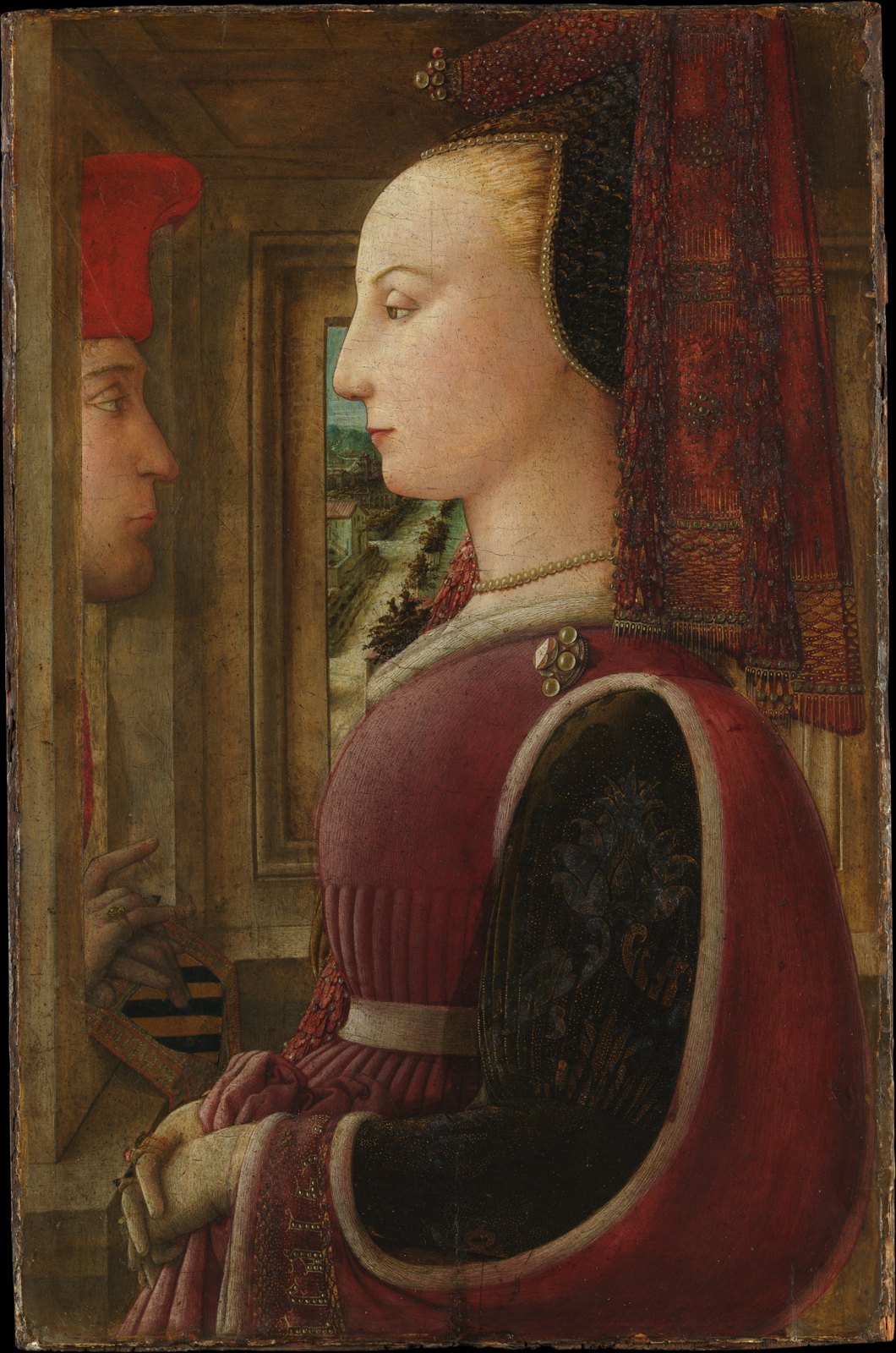
Lippi’s double portrait places a richly dressed woman inside a room and a man at its window. Painted around 1440, it helped establish new possibilities for Italian portraiture: two sitters, domestic space, and a distant landscape. A family coat of arms and an embroidered promise suggest a marriage, though the identities remain uncertain.
The story
The woman occupies nearly the whole height of the panel. Her face is in profile, her elaborate headdress reaches toward the top, and her red clothing forms a broad curve at the right. The man has far less space. He peers through an opening at the left, with only part of his body available to view. Lippi makes their unequal positions the central visual fact of a portrait that is nevertheless about a pair.
Painted around 1440, the work is the earliest surviving Italian double portrait, and an early landmark in placing portrait subjects within a domestic setting with a view of landscape. Its likely connection with marriage rests on particular clues rather than a fully documented identification. The man displays the Scolari coat of arms; the woman’s sleeve bears the word lealta, meaning faithfulness. They may be Lorenzo di Ranieri Scolari and Angiola di Bernardo Sapiti, married around 1436, but the proposal remains uncertain.
The architecture complicates the apparent simplicity of the profiles. Window frames, a rear opening, and the ceiling make a sequence of spaces within a very narrow picture. A glimpse of distant landscape extends the scene beyond its crowded interior. The woman’s face is outlined against this recession rather than surrounded by an empty field. Her clothing and jewelry supply another kind of structure: repeated beads, bands, and edges distinguish surfaces that could otherwise merge into one display of wealth.
The man’s hands and the striped coat of arms turn the window ledge into a place of exchange. His gaze meets the woman’s profile across the narrow gap, but she remains the dominant form. Her headdress and sleeve receive an attention that makes dress part of the portrait’s meaning, not a decorative afterthought. Whatever the sitters’ precise identities, the panel joins individual appearance to family affiliation and an anticipated social relationship. The spatial awkwardness is productive: two people are connected while occupying different kinds of space, with the room itself helping to describe their connection.
A closer look
Details worth noticing.
The striped shield
The Scolari coat of arms beneath the man’s hands supports a proposed identification of the couple. It is evidence of family affiliation, although the sitters’ names remain uncertain.
The embroidered sleeve
Letters on the woman’s sleeve spell lealta, or faithfulness. Together with the family arms, this detail supports the possibility that the portrait marked a betrothal or marriage.
The distant opening
A narrow landscape appears beyond the interior, creating depth inside the crowded panel. The woman’s profile remains crisp against it, joining an intimate portrait with a much wider setting.
Sources & image credits
Explore the museum’s research and collection record.
Marquand Collection, Gift of Henry G. Marquand, 1889 · CC0 · Original museum image