The story behind the painting · 3 min read
Water Lilies
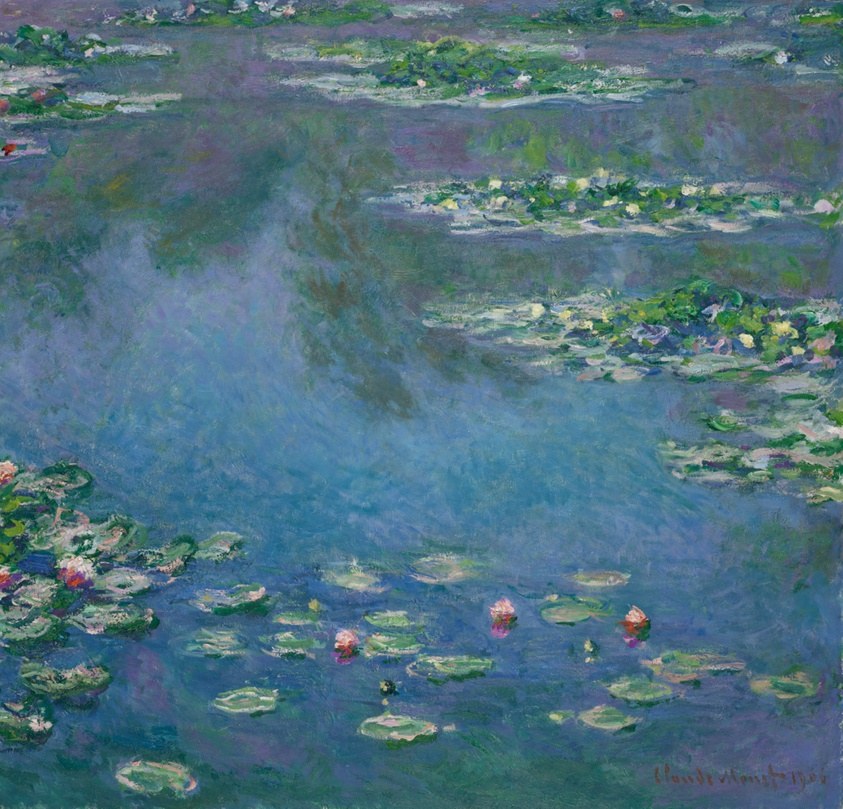
Monet's 1906 Water Lilies removes the familiar horizon and concentrates on the surface of his garden pond. Plants, reflected trees, and glimpses of sky share the same space. The peaceful effect was carefully worked: examination of the canvas has revealed substantial changes beneath its seemingly effortless arrangement of floating color.
The story
There is no clear place to stand in this landscape. No path enters the picture, and no horizon separates earth from sky. Instead, lily pads gather around a broad blue opening that can seem alternately like water, reflected air, or paint. Monet asks us to inhabit a view whose depth remains uncertain even while its subject is familiar.
The pond belonged to the water garden he established at Giverny in 1893, three years after buying the property. It became a major subject for the rest of his life. This canvas of 1906 belongs to a group made between 1903 and 1908, when his treatment of the garden increasingly concentrated on the water's surface. It precedes the later monumental paintings associated with the Orangerie in Paris.
The nearly square format supports that concentration. Lily clusters enter from several edges rather than arranging themselves along a distant bank. The lower flowers are distinct enough to anchor our attention, while other groups stretch into thinner, more continuous bands farther up. Between them, soft vertical shapes suggest the reflection of trees. The surface lets us look both at floating objects and into images of things outside the frame.
The paint changes character with those different tasks. Small bright accents lift the flowers above darker green pads. Blue and violet passages spread more broadly through the open water. Reflections seem to blur or drift, while the plants establish firmer points of contact. None of these zones becomes wholly separate: colors move across their boundaries, binding the scene into a single worked surface.
Technical study has found substantial revisions, which complicates the idea that this is simply a fleeting effect captured without hesitation. Its openness was made through sustained decisions. The eye can travel through the central blue area and then be caught by a pink bloom, a pale rim, or a dark reflected mass. There is no single destination. The painting gives a small patch of garden the visual reach of a much larger world, using reflections to bring an unseen sky and surrounding trees into the pond itself.
A closer look
Details worth noticing.
A horizonless garden
The frame excludes the bank and the horizon. Without those familiar markers, lily pads and reflections become the principal clues for reading distance across the whole painted surface.
Pink points of contact
Small pink flowers punctuate the lower portion of the pond. Their compact, bright shapes give the eye firm resting places within the broader blue and violet passages of water.
Trees without trunks
Dark vertical reflections enter the upper water while the trees themselves remain outside the frame. Their softened edges make the same surface read as both a pond and a mirror.
Sources & image credits
Explore the museum’s research and collection record.
- Art Institute of Chicago: collection record ↗
- Art Institute of Chicago: museum catalogue and open-access record ↗
Mr. and Mrs. Martin A. Ryerson Collection · CC0 · Original museum image