The story behind the painting · 3 min read
Two Sisters (On the Terrace)
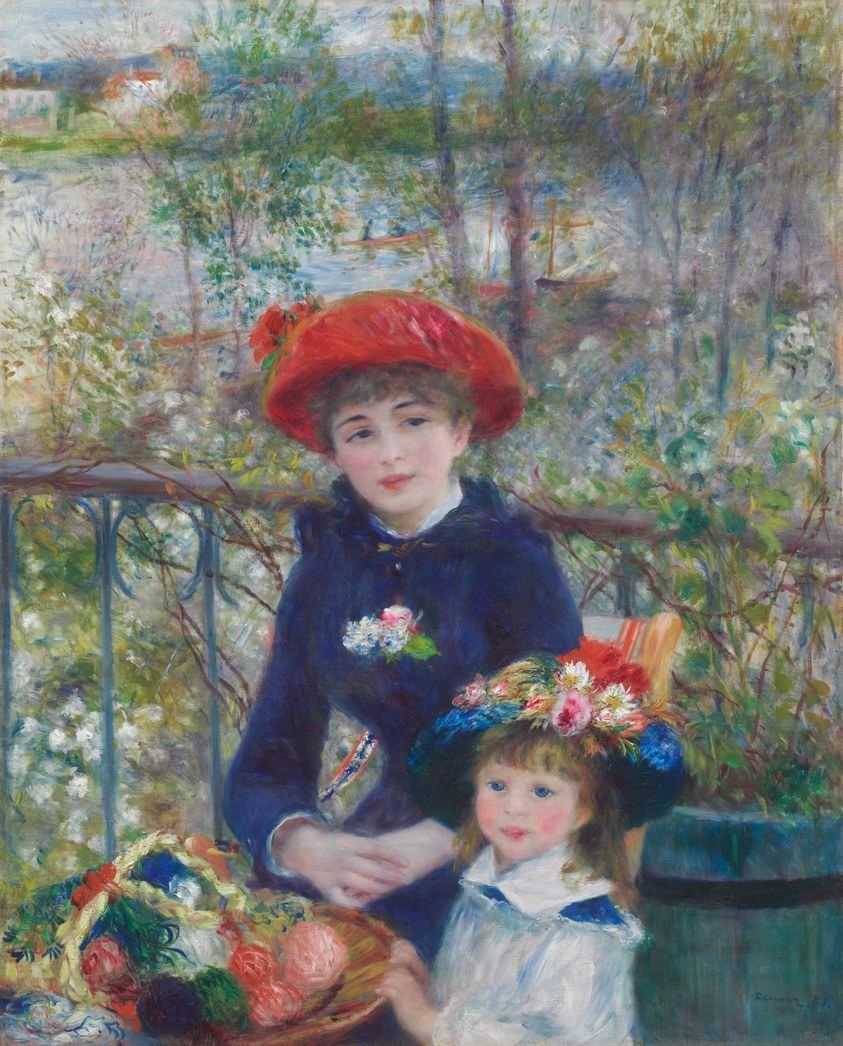
Renoir's two sitters were paid models, not sisters, despite the painting's familiar title. He posed them at the Restaurant Fournaise in Chatou, a riverside escape from Paris. Their carefully painted faces contrast with the loose trees and water behind them, while hats, flowers, and yarn distribute bright color across the terrace.
The story
The older sitter's red hat announces itself against the pale river landscape. Below it, her dark blue outfit forms a calm, substantial shape. Beside her, a smaller child wears a hat crowded with flowers. The two faces look outward from a setting that seems to shimmer around them, making the figures feel both close to us and sheltered within the terrace.
Renoir painted the scene at the Restaurant Fournaise in Chatou, a village on the Seine where he enjoyed the combination of landscape and company away from Paris. The work was exhibited with the Impressionists in 1882. Its title suggests a family relationship, but the sitters were unrelated paid models. The intimacy is a pictorial construction rather than evidence of an actual pair of sisters.
The older figure wears the blue flannel associated with a female boating outfit. Its deep color gives the faces and flowers a strong setting. Her hands rest together near the center, forming a pale horizontal shape above the basket. The child touches the basket's edge, connecting the two figures to the colored yarn inside. Clothing and accessories are not incidental details; they organize the painting's largest contrasts and smallest echoes.
The handling of paint shifts noticeably between foreground and distance. The faces are controlled and relatively smooth, with carefully placed eyes and mouths. Behind the railing, branches, water, and boats are described more loosely. The background does not compete by becoming equally precise. Instead, its broken, airy surface surrounds the sitters with a different rhythm, allowing their stillness to register without making the whole scene rigid.
The yarn basket is an especially rewarding passage. Red, green, blue, and pale strands answer the colors of the hats and surrounding vegetation. Its tangled forms are anchored by the basket's curved edge, just as the busy landscape is held behind the terrace railing. Renoir makes a setting full of small distractions feel balanced through these repetitions. Once the misleading family title is set aside, the painting remains persuasive: closeness is produced through scale, placement, shared color, and the gentle meeting of separate gazes.
A closer look
Details worth noticing.
Sisters only in the title
The models were not related. Renoir paid them to pose together, so the sense of family intimacy comes from the painting’s arrangement rather than a documented bond between the sitters.
A basket of repeated colors
The yarn collects reds, greens, blues, and pale tones already scattered through the hats and setting. This small foreground object condenses the painting’s larger palette into a single place.
Two speeds of painting
Compare the carefully defined faces with the loose branches behind them. The contrast makes the sitters seem steady and close while the riverside background remains airy and visually active.
Sources & image credits
Explore the museum’s research and collection record.
- Art Institute of Chicago: collection record ↗
- Art Institute of Chicago: museum catalogue and open-access record ↗
Mr. and Mrs. Lewis Larned Coburn Memorial Collection · CC0 · Original museum image