The story behind the painting · 3 min read
Wheat Field with Cypresses
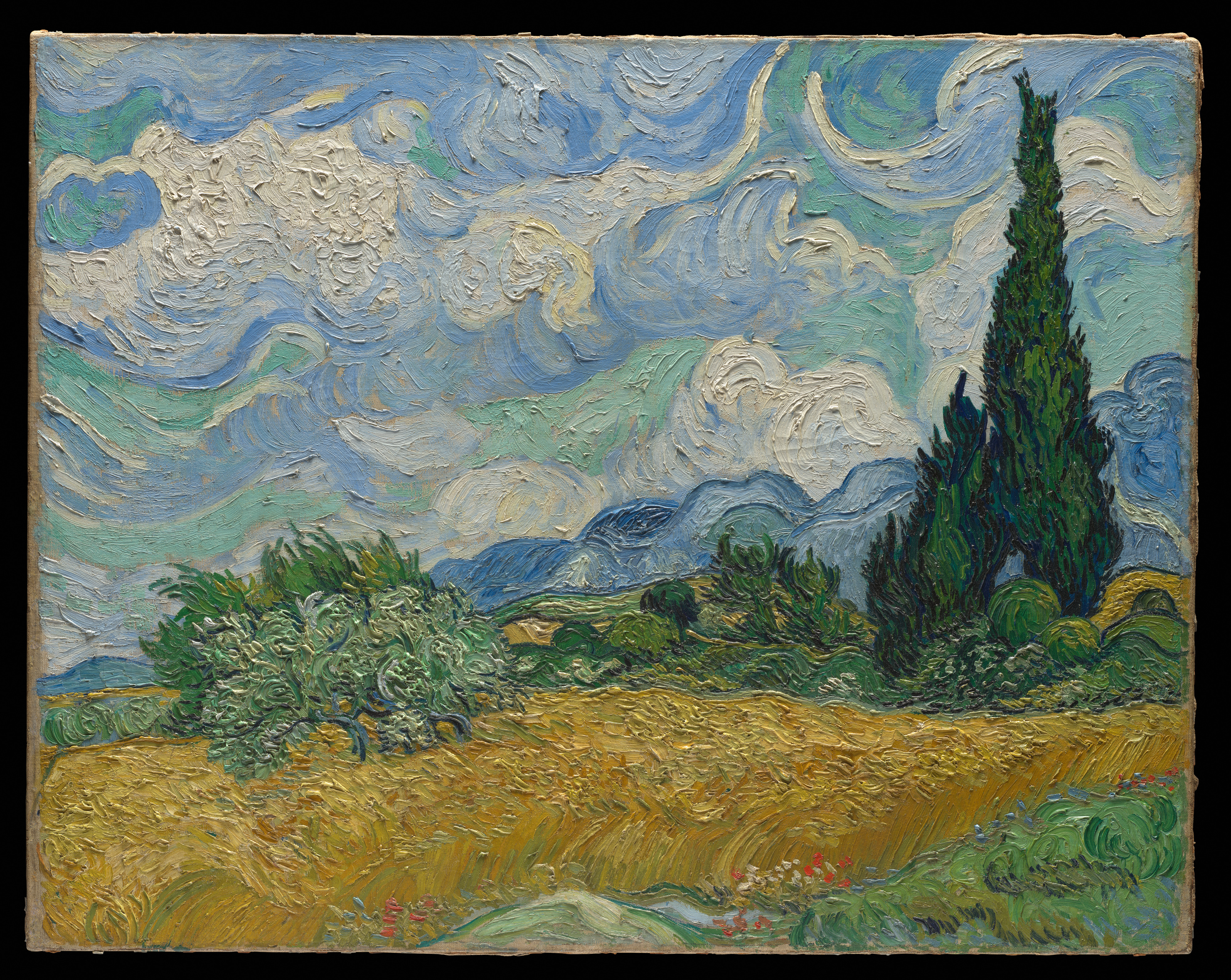
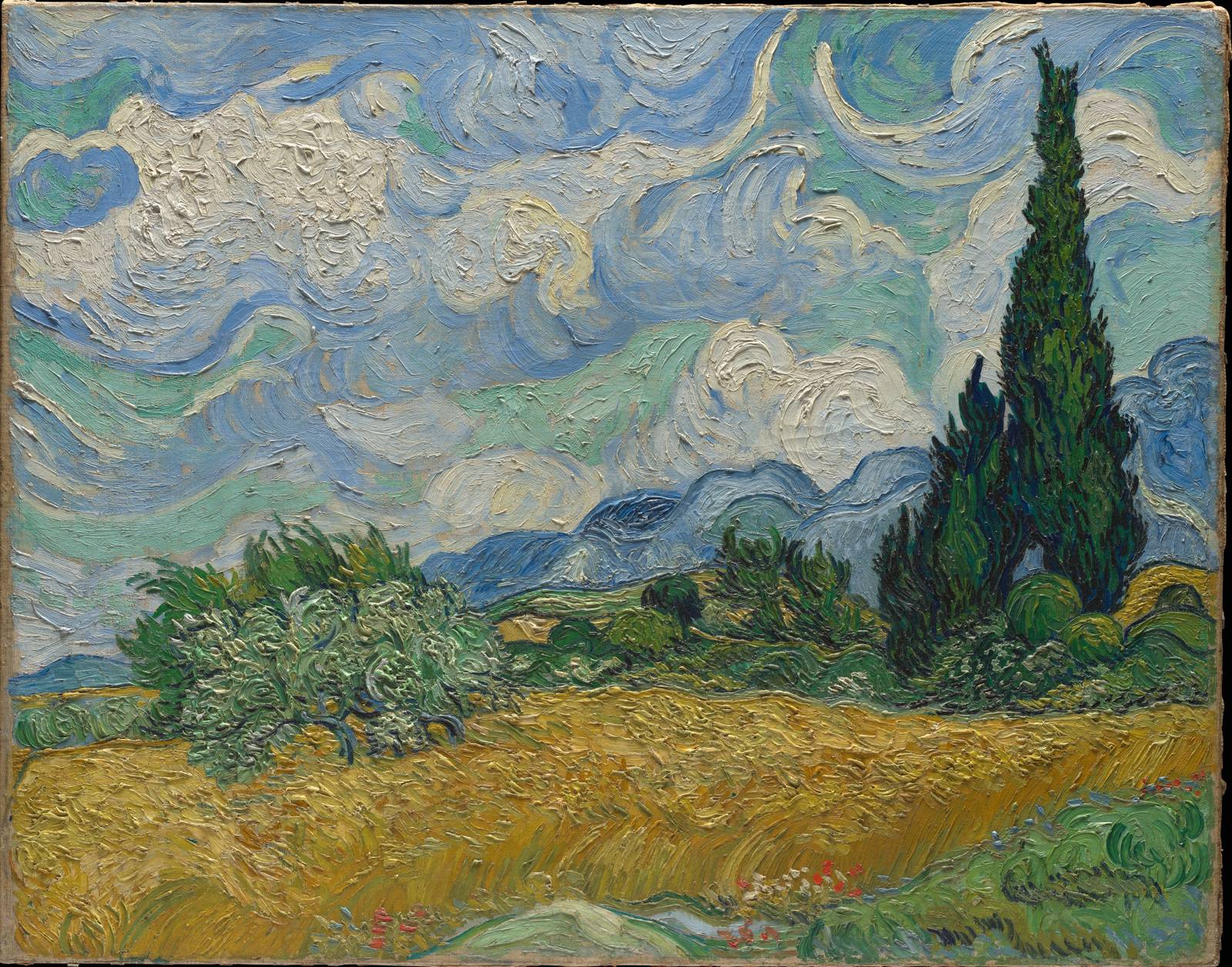
Vincent van Gogh painted this landscape outdoors at Saint-Rémy in 1889, bringing the same restless brushwork to wheat, trees, and clouds. He valued the result enough to make two further versions in his studio. The dark cypresses hold the composition together while almost everything around them seems to move.
The story
The field is yellow, the mountains blue, and the trees green, but these familiar colors do not sit quietly in their assigned places. Blue runs through the foliage, pale green enters the sky, and white curls through clouds like ridges of cream. Van Gogh builds a landscape whose different parts seem to share one nervous, lively substance. The brushstrokes remain visible as individual decisions even while they combine into an immediately recognizable summer scene.
He painted this canvas directly from nature at Saint-Rémy in 1889, when cypresses had become a sustained interest. By early July he was sending his brother Theo drawings of the composition. His pleasure in the result was practical as well as emotional: in September he made another full-size version and a smaller one intended for his mother and sister. This painting was therefore both a response to a particular place and a design he wanted to reconsider and share.
The great cypress on the right supplies the firmness that the rest of the picture withholds. Its pointed top reaches toward the upper edge; its base disappears among lower, rounder bushes. Dense, dark strokes give it weight against the pale clouds. Yet even this apparent anchor is made of twisting marks. The tree does not oppose the movement of the landscape so much as gather that movement into a tall, concentrated shape.
Across the lower part of the canvas, short strokes turn the wheat into a textured band rather than a smooth patch of gold. The curved boundary at the right stops that band from becoming rigid. Above it, the mountains rise and fall in blue waves, answering the contours of the clouds. No figure provides a story or a scale marker. The event is the encounter between a place and the act of painting it: heat, growth, air, and pigment held together on one emphatically worked surface.
A closer look
Details worth noticing.
The tall cypress
The darkest tree gives the bright landscape a vertical anchor. Its twisting green strokes echo the curves in the clouds, linking the ground and sky through repeated movement.
The painted wheat
Small, slanting marks break the field into individual touches of yellow, green, and ocher. Their changing directions make the crop feel uneven and alive rather than uniformly golden.
The cloud ridges
Thick white paint makes the clouds physically raised as well as visually bright. Blue and green remain between the curling strokes, preventing the sky from becoming a flat backdrop.
Sources & image credits
Explore the museum’s research and collection record.
Purchase, The Annenberg Foundation Gift, 1993 · CC0 · Original museum image