The story behind the painting · 3 min read
The Death of Socrates
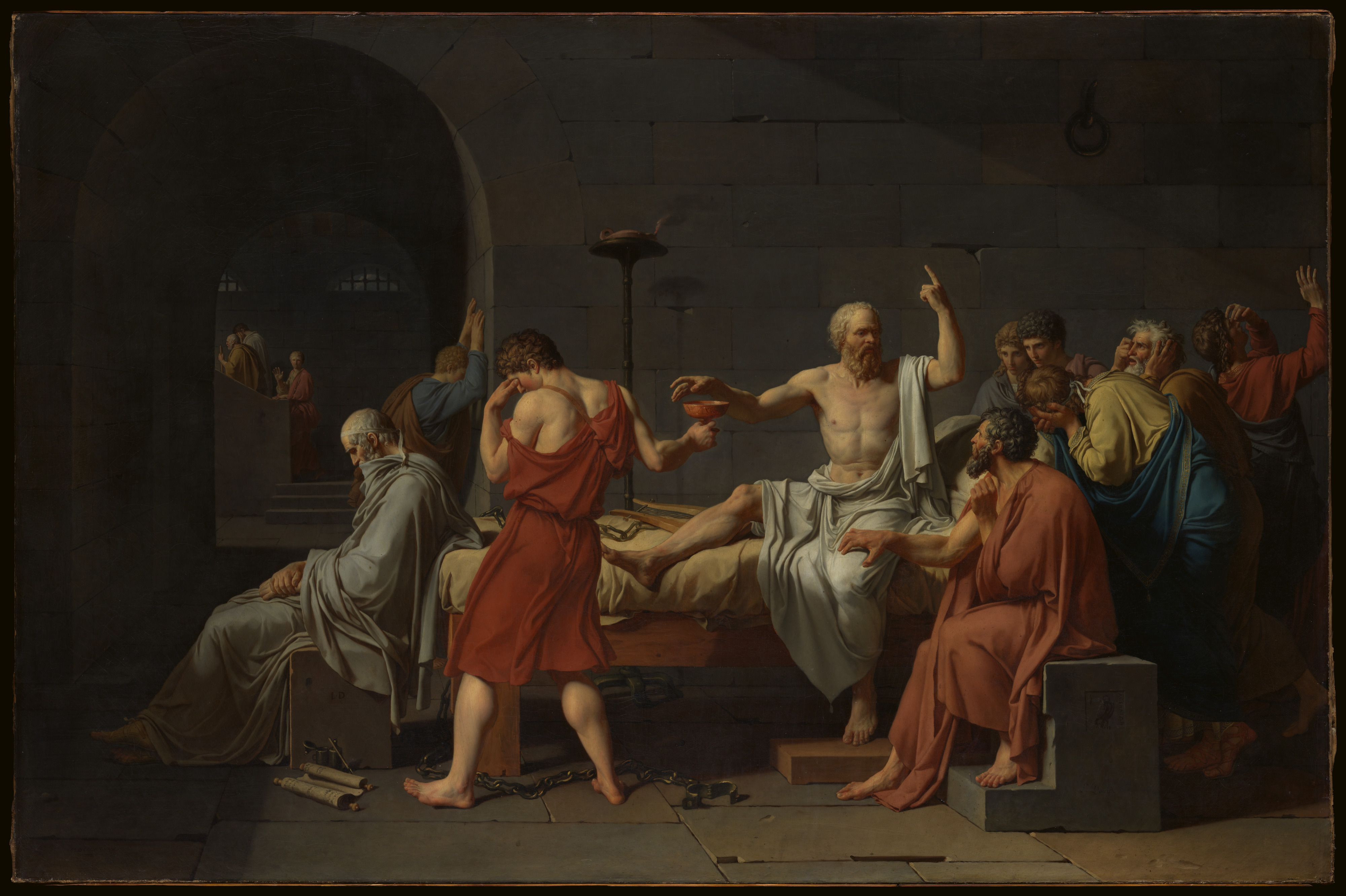
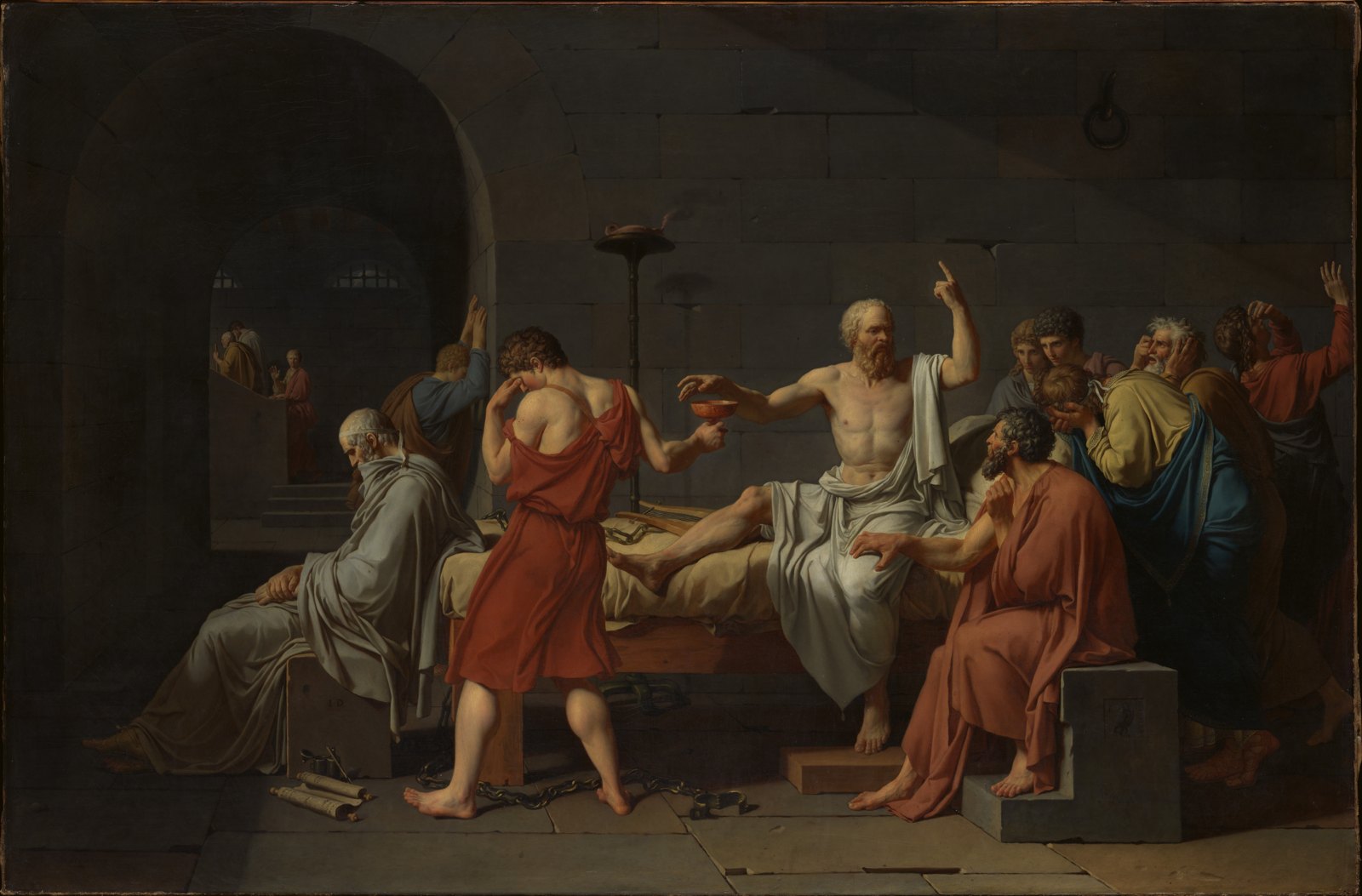
Jacques Louis David turns the death of Socrates into a drama of conviction: the philosopher reaches for hemlock while continuing to teach. Painted in 1787, the scene draws on an ancient account but deliberately includes Plato, who was not present. Controlled gestures and hard stone surroundings make emotional differences sharply visible.
The story
The cup has not yet reached Socrates, and that small interval holds the entire scene in suspense. One hand stretches toward it while the other points upward. His companions fold, turn away, cling, or cover their faces; he sits upright. David makes the central figure seem almost exempt from the physical weight that pulls the others down, although the poison about to end his life is already within reach.
In 399 BCE, an Athenian court condemned Socrates for impiety. David presents his acceptance of death as fidelity to belief, connecting the raised hand with his final discussion of the soul’s immortality. The painting dates to 1787, shortly before the French Revolution. Its severe setting and clearly articulated bodies belong to Neoclassicism, an approach that used ancient subjects and forms to give contemporary audiences examples of moral choice.
This is a carefully composed argument rather than an eyewitness reconstruction. The gray-haired man seated at the foot of the bed is Plato, whose Phaedo transmitted the story, though he was not there. His stillness differs from the urgent gestures around Socrates. Meanwhile the man carrying the cup twists his face away from the very action his arm performs. David turns opposite movements within a single body into a concise image of reluctance.
The room makes every gesture easier to read. Horizontal blocks of stone, the bed, and the figures spread across the foreground create a shallow stage; the dark arch at the left opens a more distant passage without dissolving that order. Red garments concentrate attention around the cup and the seated companion at the right. Bright white cloth separates Socrates from the darker surroundings. The smooth surface of the painting offers little distracting brushwork. Bodies, hands, and intervals do the speaking, leaving the viewer with a choice that is clear in its terms and painful in its consequences.
A closer look
Details worth noticing.
Plato at the bedside
The seated man at the left is Plato, included because his writing preserved the story. His presence is deliberate invention rather than evidence that he witnessed the death.
The offered cup
The cup bearer turns his face away while extending his arm. David divides a single figure between the duty of delivering the poison and the difficulty of watching.
The lifted finger
Socrates points upward while his other hand approaches the cup. These simultaneous gestures connect the argument about an immortal soul with the immediate prospect of his bodily death.
Sources & image credits
Explore the museum’s research and collection record.
Catharine Lorillard Wolfe Collection, Wolfe Fund, 1931 · CC0 · Original museum image