The story behind the painting · 3 min read
Stag at Sharkey's
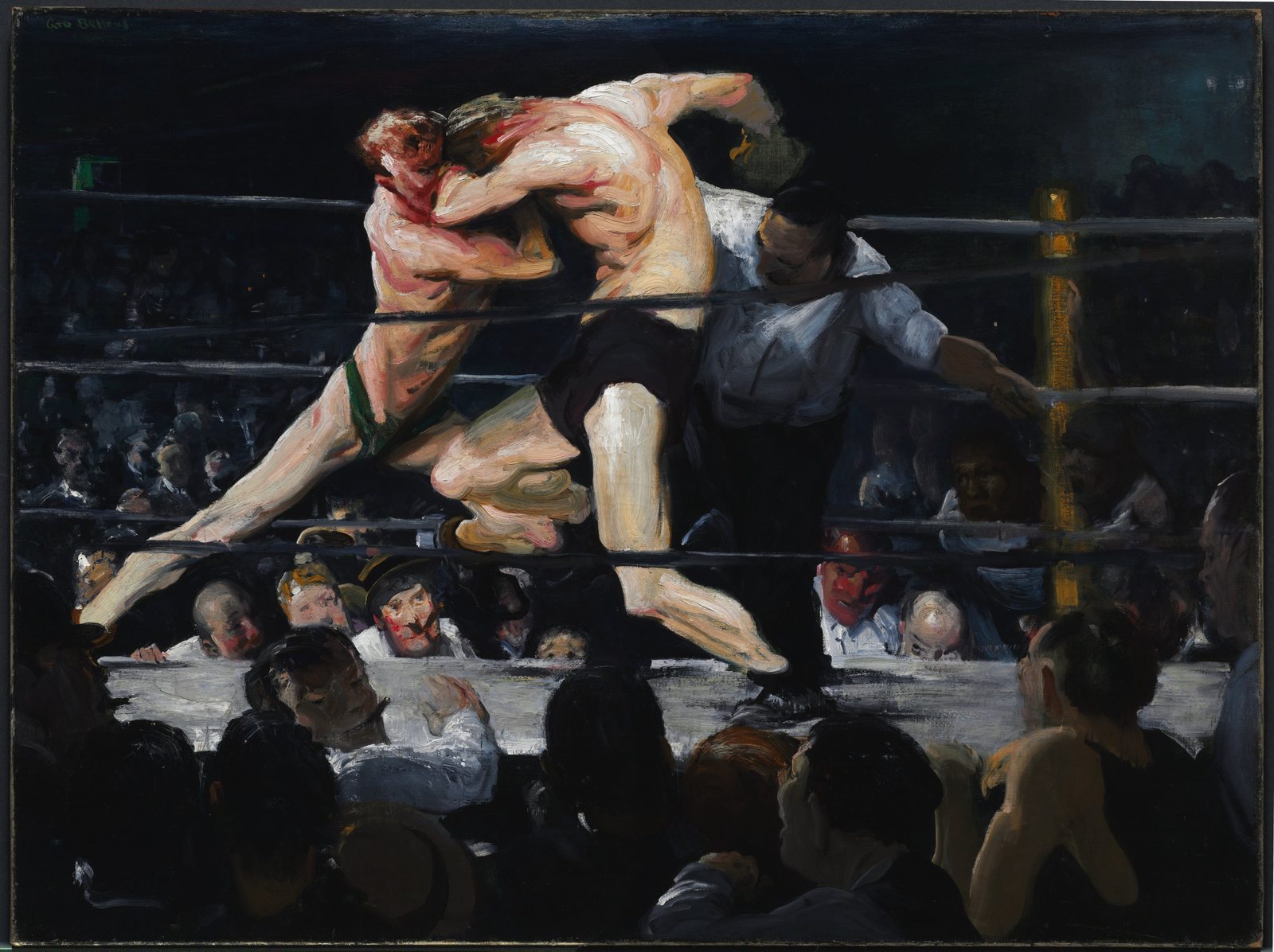
George Bellows painted a boxing club where a legal loophole turned outsiders into temporary members, or “stags.” The crowded room and colliding bodies show why the sport fascinated and unsettled early twentieth-century audiences. The painting makes the spectators part of the action: faces press toward the ring while pale limbs flash against the darkness.
The story
Two bodies meet so forcefully that their separate outlines become difficult to untangle. One fighter's leg stretches across the ring, while the other's back arches beneath the light. Around them, heads rise just above the canvas floor. Bellows gives the central collision an almost uncomfortable proximity: the spectators seem close enough to feel its momentum, and the painting places us among them.
Sharkey's Athletic Club occupied a saloon near Bellows's New York studio. Its founder, Tom “Sailor” Sharkey, was a former boxer and navy man. Public boxing was illegal in the city, so bouts could be arranged as private club events. An outsider admitted temporarily to compete was called a stag. The title identifies that social arrangement rather than naming either of the fighters.
Bellows knew competitive sport himself, having played baseball and basketball at Ohio State University. Yet the picture does not read like an orderly explanation of technique. Shoulders, arms, and legs become long, vigorous strokes. Red touches around the faces intensify the clash. The referee leans into the same compressed space, his darker clothing partly merging with the people beyond. Almost every visible body responds to what is happening at the center.
The ring ropes make a revealing counterpoint. Their straight lines hold the space in place while the fighters appear to twist against it. Below, faces emerge unevenly from shadow: a bright forehead, an open mouth, a raised chin. Bellows does not finish every spectator equally. That broken visibility produces the sensation of a room glimpsed in bursts, with attention continually pulled back to the lit skin of the men in motion.
Boxing attracted both condemnation and enthusiasm. Some saw brutality; supporters regarded the sport as a test of vigor and manliness. By 1909 it was gaining an audience beyond its predominantly working-class base. Bellows does not resolve those conflicting responses into a simple verdict. The painting's energy is compelling, but the proximity of its watching faces also exposes the appetite that makes the event possible. The fight and the crowd cannot be separated.
A closer look
Details worth noticing.
The temporary member
A “stag” was an outsider given temporary club membership to box. Private membership enabled bouts to take place when public boxing was illegal in New York City.
The ring ropes
Straight ropes cut across the twisting bodies. Their stability makes the fighters’ bent backs and extended legs appear more forceful, while establishing the shallow space between us and them.
Faces at ringside
Small patches of light pick individual faces out of the dark crowd. Uneven detail recreates selective attention: a mouth or forehead registers before a whole person does.
Sources & image credits
Explore the museum’s research and collection record.
Hinman B. Hurlbut Collection · CC0 · Original museum image