The story behind the painting · 3 min read
The Biglin Brothers Turning the Stake
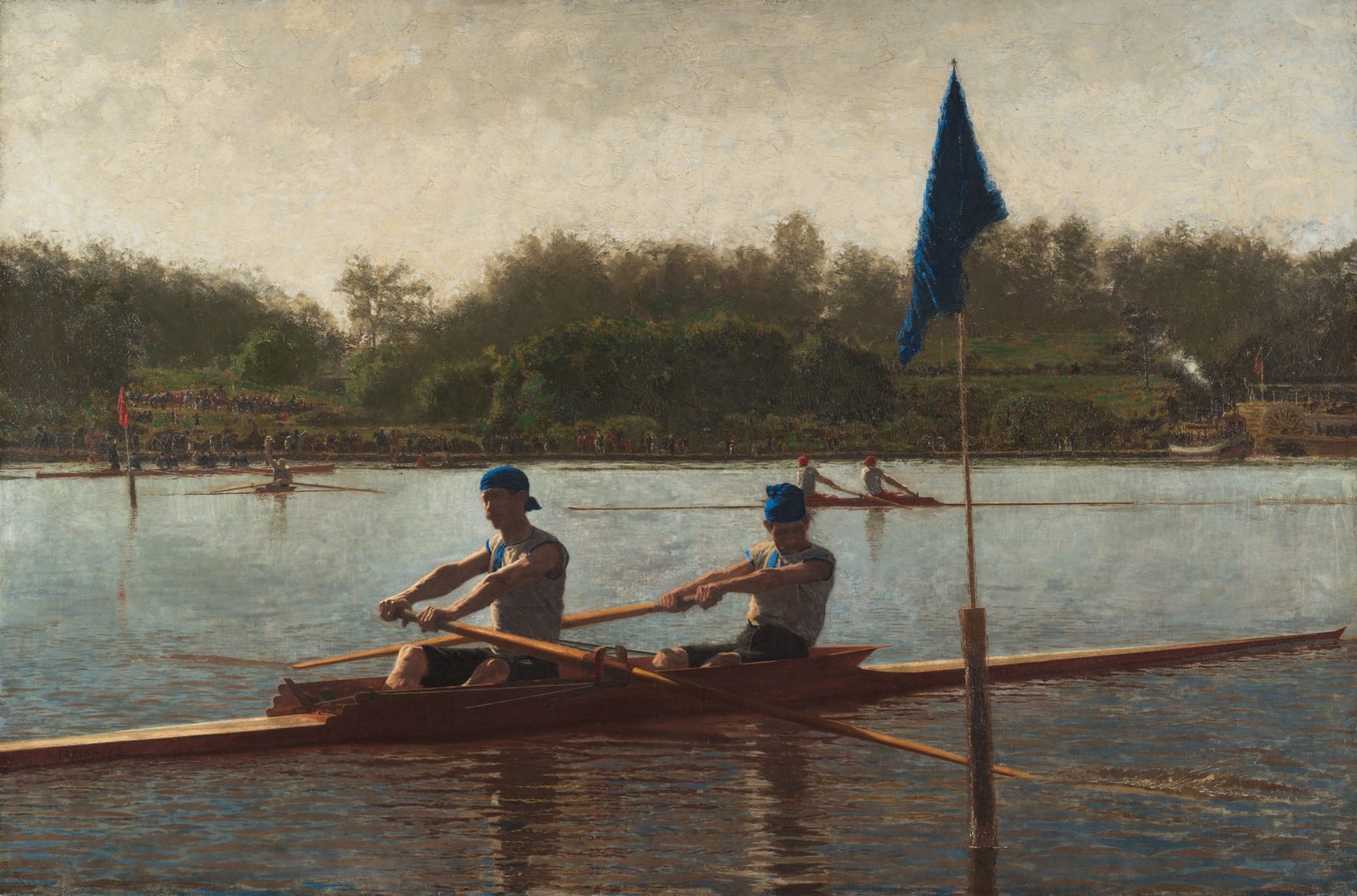
Thomas Eakins chose a demanding turn rather than a finish-line celebration to portray the champion rowers Barney and John Biglin. The scene recalls their May 1872 race on Philadelphia's Schuylkill River. Precise spacing, coordinated bodies, and the distant rival boat turn an apparently quiet river view into a study of athletic judgment.
The story
A blue flag rises near the front of the painting, marking the point around which a long racing boat must turn. The two rowers sit low against the river, their arms extended and their bodies working in relation to one another. The scene looks measured rather than explosive. Its drama depends on distance, timing, and the careful management of a narrow craft.
The men are Barney and John Biglin, celebrated professional oarsmen. Eakins commemorated a race held on Philadelphia's Schuylkill River in May 1872. They are rounding the stake at the halfway point, with their opponents farther away on the right. The brothers went on to win. Knowing the result gives the image a particular tension: we see an important maneuver on the way to victory, rather than victory presented as a completed fact.
Rowing drew large audiences in the United States during the 1870s. Eakins compresses that public interest into the small figures gathered along the opposite bank. Their scale makes the width of the river tangible. Against this distant strip of spectators, the brothers appear isolated and highly visible. The river becomes an arena without enclosing walls, and the blue flag supplies the practical marker that makes its open space a course.
Eakins trained in both the United States and France but spent most of his working life in Philadelphia. His preparations included detailed studies of figures and perspective. That method is felt here in the relationships among the boat, oars, bodies, and stake. Long horizontal lines establish the calm surface; diagonals record the labor required to cross it. The narrow hull almost disappears beneath the men, so that the equipment's lightness becomes part of our understanding of their skill.
The reflections are less crisp than the objects above them. Strokes interrupt the mirrored flag and soften the boat's presence in the water, reminding us that this measured structure rests on a moving surface. Athletic coordination becomes visible through these contrasts: steady arms against rippling water, a turn against straight lines, concentrated effort against a distant crowd. Eakins makes teamwork convincing through the exact arrangement of ordinary physical things.
A closer look
Details worth noticing.
The halfway stake
This stake marks the turn at the race’s halfway point. The Biglins must change direction together without surrendering the lead visible in the gap to their distant opponents.
The blue caps
Repeated blue caps visually pair the brothers, but their arms and torsos occupy different positions. Eakins shows coordinated work through related actions rather than identical, decorative poses.
The distant audience
The tiny spectators on the far bank establish the river’s breadth. Their compressed scale also separates the public spectacle from the concentrated effort of the two foreground rowers.
Sources & image credits
Explore the museum’s research and collection record.
Hinman B. Hurlbut Collection · CC0 · Original museum image