The story behind the painting · 3 min read
Paris Street; Rainy Day
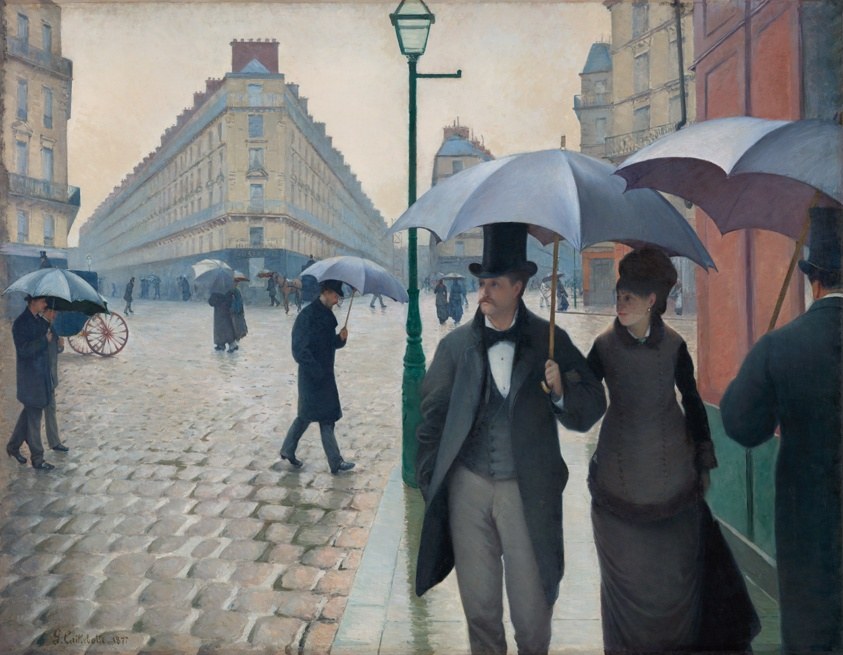
Gustave Caillebotte made wet Paris feel immediate without filling the air with painted raindrops. Umbrellas, glistening paving, and abruptly cropped pedestrians establish the weather and the crowd. The intersection was near his home, but the monumental canvas transforms a familiar neighborhood into an encounter with the scale of the modern city.
The story
A couple approaches so closely that we seem about to share their pavement. At the right edge, another pedestrian is already partly outside the picture. Beyond them, the street opens into an unusually broad expanse of wet stone. Caillebotte makes the viewer feel both placed inside the city and temporarily in someone else's way.
He painted an intersection a short walk from his home in Paris. It was familiar territory, but its wide roads and emphatic architecture belonged to a city transformed by redevelopment. The great wedge of building in the background gathers the street lines toward it. Instead of offering a tidy view of an isolated landmark, the painting shows how buildings, roads, and passing bodies organize an ordinary urban experience.
Caillebotte exhibited with the Impressionists and shared their interest in contemporary life, yet his surfaces here are more controlled than the broken brushwork often associated with the group. Coats have weight, umbrella ribs describe a clear structure, and the paving is carefully differentiated. Photography may have encouraged his dramatic cropping. That is a possibility rather than a proven explanation, but it helps describe the image's sense of a moment caught midstream.
The rain is communicated through its consequences. Umbrellas occupy the sky above the pedestrians. Pale reflections interrupt the gray paving, making the ground look slick. The foreground man's umbrella overlaps the nearer stranger's, bringing two separate paths uncomfortably close. Farther back, small isolated walkers are placed at intervals across the open road. Their spacing creates movement without needing a blur or a theatrical gesture.
The central lamppost divides the composition but does not make its halves equivalent. One side holds the near couple; the other gives more room to buildings and distance. That imbalance is essential to the experience. We can look far into the intersection and still be arrested by a coat sleeve only inches away in pictorial space. Caillebotte turns the simple act of walking in the rain into a remarkably precise study of proximity, distance, and shared public ground.
A closer look
Details worth noticing.
Weather without raindrops
The shine on the paving carries much of the weather. Reflections soften the street’s hard geometry, allowing the rain to be felt through surfaces rather than individually painted falling drops.
The cropped passerby
The figure cut by the right edge makes the scene extend beyond its frame. His umbrella approaches the couple’s, introducing a near collision into the otherwise measured arrangement.
A dividing lamppost
The upright post separates near figures from the more open street. Follow it downward to see how a simple vertical steadies the many diagonal lines receding through the city.
Sources & image credits
Explore the museum’s research and collection record.
- Art Institute of Chicago: collection record ↗
- Art Institute of Chicago: museum catalogue and open-access record ↗
Charles H. and Mary F. S. Worcester Collection · CC0 · Original museum image