The story behind the painting · 3 min read
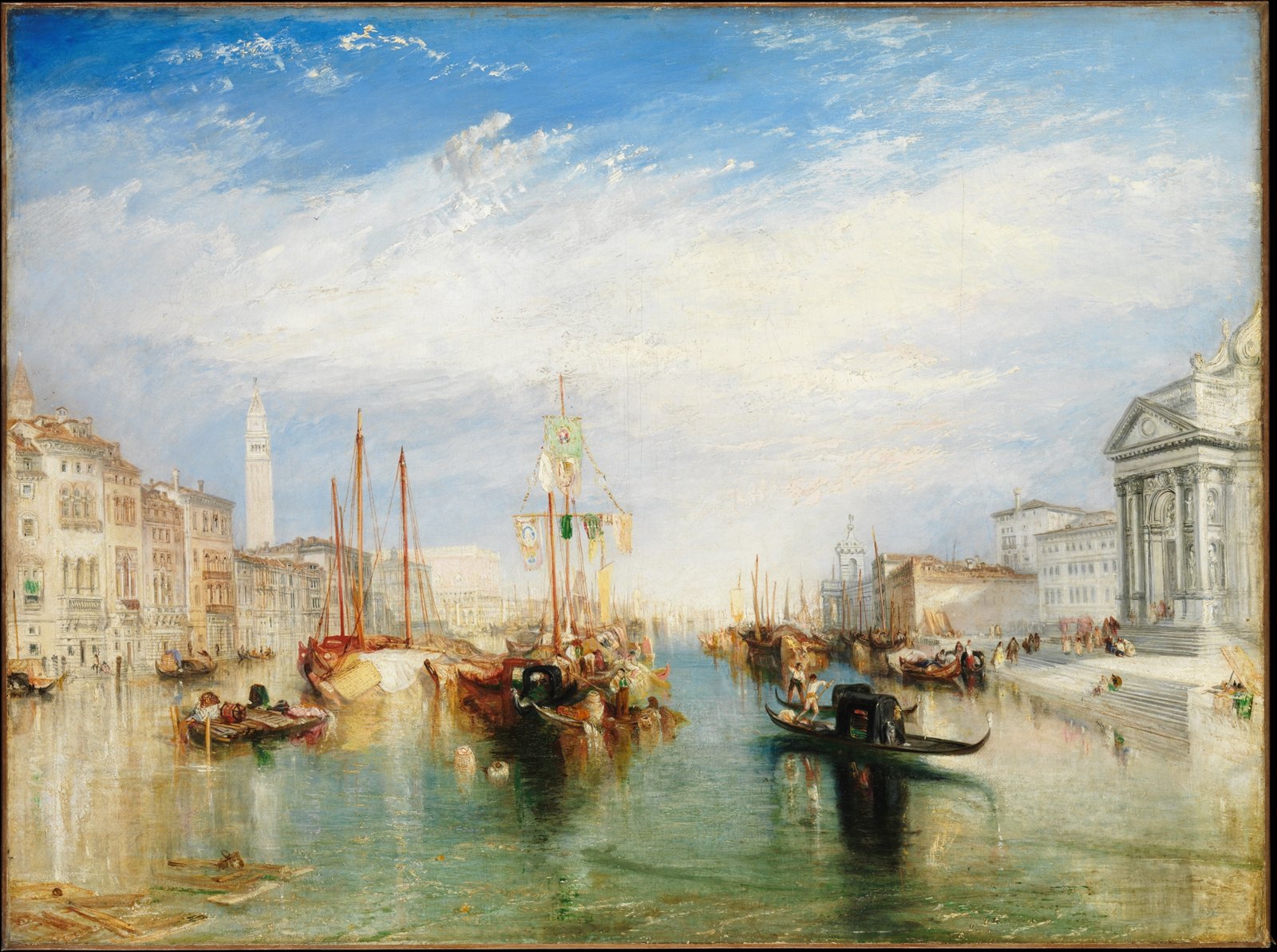
Venice, from the Porch of Madonna della Salute
Turner’s Venice seems to hover between masonry and reflection. Painted around 1835 after two visits to the city, this view combines experience of marine painting with the luminous effects he developed in watercolor. The canvas was acclaimed at the Royal Academy, where its light transformed a recognizable city into an atmospheric spectacle.
The story
The buildings appear solid near the edges and increasingly fragile toward the center. Their pale walls almost dissolve into the brightness above the water, while reflections lengthen them downward into unstable columns. Venice is recognizable as a city of palaces, boats, and channels, but its material solidity seems negotiable. Turner gives light nearly as much presence as architecture, allowing the sky and water to take up most of the picture.
He had visited Venice in 1819 and returned in 1833. A modest pencil sketch from the first visit supplied the basis of this composition; the later encounter helped produce the painting, exhibited at London’s Royal Academy in 1835. His experience with maritime subjects and watercolor fed into the oil technique here. The result was well received, a reminder that a picture can appear startlingly loose to a modern viewer and still have found an appreciative public in its own moment.
The boats keep this brilliance from becoming shapeless. Dark hulls punctuate the water, and thin red-brown masts cut vertical lines through the light. A covered black gondola near the right foreground is particularly definite: its mass is easy to distinguish even as the reflections beneath it break apart. Small figures and cargo supply signs of ordinary activity, but they never compete with the overall effect of the place. The city is inhabited without becoming a crowded anecdote.
The largest shapes are remarkably simple. A broad blue opening crosses the top, a luminous band of cloud spreads below it, and the channel narrows toward the center. Within that structure, tiny changes of color do the work of stone, ripples, fabric, and distant movement. There is no need for every window to be equally sharp. The contrast between a few precise accents and many softened passages lets the eye experience both the city’s intricate construction and the light that makes its edges uncertain.
A closer look
Details worth noticing.
The dark gondola
The black covered boat near the right gives the pale scene a firm weight. Its dark reflection breaks into the green water, making solidity and movement coexist.
The slender masts
Fine reddish masts rise through the light like drawn lines. Their crispness makes the surrounding haze more apparent and gives the clustered boats a structure beyond their small hulls.
The palace reflections
The buildings continue into the canal as pale, broken streaks. Their reflections make the boundary between stone and water uncertain, an effect central to Turner’s luminous view of Venice.
Sources & image credits
Explore the museum’s research and collection record.
Bequest of Cornelius Vanderbilt, 1899 · CC0 · Original museum image