The story behind the painting · 3 min read
The Race Track (Death on a Pale Horse)
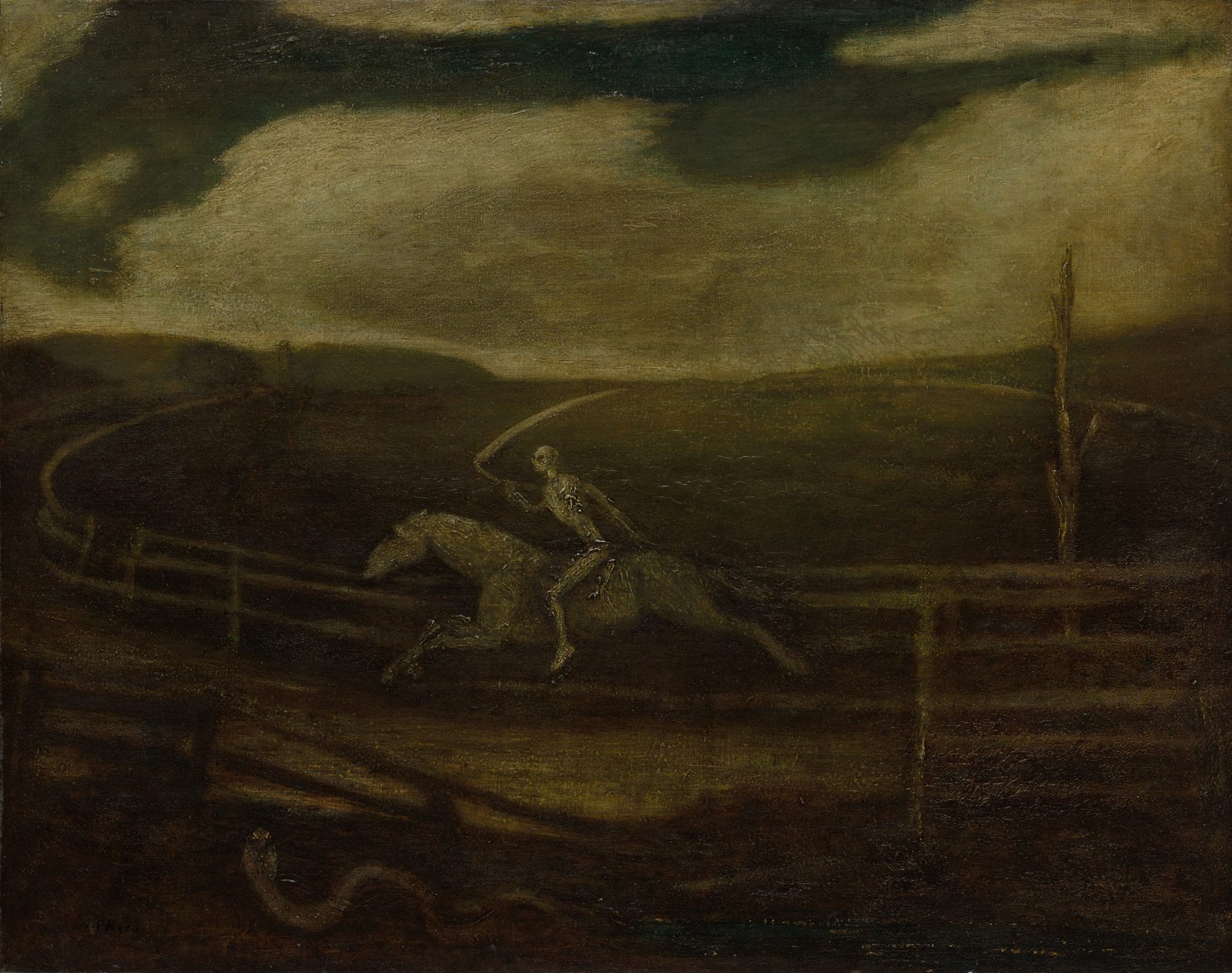
Albert Pinkham Ryder transformed a horse race into a dark image of mortality after a friend's death. A skeleton rides alone around the track, carrying a scythe, while a snake occupies the foreground. The empty circuit replaces the excitement of competition with repetition, isolation, and the knowledge that no ordinary victory is possible.
The story
The track curves away through a landscape almost emptied of life. There are no cheering spectators and no field of competing horses. A single pale animal carries a skeletal rider beneath a heavy sky. Fences mark out a familiar sporting space, but the ordinary purpose of that space has disappeared. The very shape of the course, returning upon itself, becomes the painting's most unsettling structure.
Ryder's subject arose from a New York horse race in 1888. A friend lost a large wager and subsequently died by suicide. The painting does not reconstruct the event or portray the friend. Instead, Ryder translated the loss into an allegory: an image in which recognizable figures and objects carry meanings beyond the literal scene. He worked on the canvas over several years and found it difficult to part with.
The rider's scythe identifies Death through an established symbolic language. The tool used to cut down crops becomes a sign of lives brought to an end. A snake in the foreground adds the traditional association of temptation and evil. These are deliberate emblems, unlike the anonymous hills and clouds around them. Together they turn the racecourse into a setting for consequences that extend beyond any particular contest.
The paint makes those emblems strangely hard to grasp at first. Horse and rider do not blaze out in bright white; they hover in dull, earthy light. The fence appears and disappears as its lines cross the dark ground. Above, a long cloud presses downward, repeating the broad movement of the track. The landscape feels closed even where it opens toward the distance. There is space to ride, but little visual sense of escape.
Ryder's limited colors are essential to that effect. Small differences among brown, olive, and muted yellow matter more than sharp contrasts. The horse emerges slowly, and the snake becomes a second, much smaller curve near the picture's edge. These repeated bends connect the living creature, the running animal, and the enclosing course. The result is not a report of a sporting tragedy but a sustained meditation on loss, shaped through the materials and rhythms of a landscape.
A closer look
Details worth noticing.
The rider’s scythe
The skeleton carries the traditional attribute of Death: a harvesting tool that becomes a figure for the cutting short of human lives. It changes a race into an allegory.
The foreground snake
The snake carries an established association with temptation and evil. Its small curved body repeats the larger curves of the track, linking the foreground to the rider’s circuit.
The pale horse
The horse is only slightly lighter than its surroundings. That restricted contrast makes its shape emerge gradually from the dark, rather than presenting it as a sharply separated apparition.
Sources & image credits
Explore the museum’s research and collection record.
Purchase from the J. H. Wade Fund · CC0 · Original museum image