The story behind the painting · 3 min read
The Bedroom
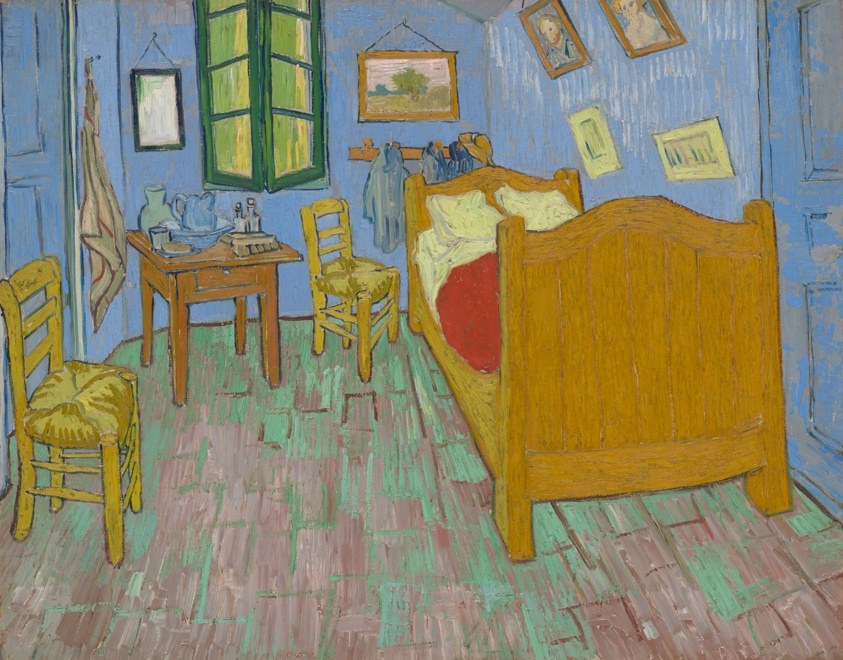
Vincent van Gogh painted this version of his bedroom in September 1889, nearly a year after the original. The room belonged to his Yellow House in Arles. Its emphatic colors and tilting furniture can feel restless to modern eyes, although he intended the subject to convey a sense of rest.
The story
The bed seems to press forward into the room. Its yellow wooden frame is broad and solid, the red cover almost a block of pure color. Around it, the chairs, floorboards, and walls meet at angles that make the space feel immediately recognizable yet slightly unsettled. This is a modest room made visually unforgettable by the way its familiar objects are arranged.
It was Van Gogh's bedroom in the Yellow House in Arles. He first painted the subject in October 1888, shortly after moving into the house. Chicago's canvas is the second version, completed in September 1889. A third, smaller painting followed at the same time for his mother and sister. The existence of three versions matters: the image was something he chose to return to and remake, not merely a record of where he slept.
In a letter to his brother Theo about the first version, Van Gogh carefully listed the colors of walls, floor, furniture, bedding, and washbasin. Color was central to his conception of the room. Yet the energetic result was intended as an image of repose. Knowing that intention does not require us to find the painting peaceful. It makes the distance between the artist's purpose and our own bodily response more interesting.
The objects are few, and each has room to register. A basin and pitcher sit on the table; pictures occupy small areas of the walls; two chairs establish distinct places in the otherwise empty interior. The bed's large warm shape meets the cooler wall behind it. Strong contours keep individual things separate even where the perspective seems to squeeze them together. There is little incidental clutter to distract from those relationships.
Because no one is present, the room becomes a portrait through belongings and spatial choices. The paired pillows and chairs repeat simple shapes without turning the scene into a narrative we can confidently decode. Looking slowly reveals something more concrete: an artist treating everyday furniture as a complete vocabulary of line, color, and scale. A bedroom becomes a painting that can be remembered almost object by object.
A closer look
Details worth noticing.
A second bedroom
This canvas is the second of three painted versions. Van Gogh made it in September 1889, returning to a room he had first represented almost a year earlier.
The red cover
The bedcover forms the strongest warm rectangle in the room. Its broad area of red pulls the bed toward the viewer against the cooler wall and neighboring green window.
Pictures within a picture
The small framed images remain distinct rectangles on the walls. Their tilted edges repeat the room’s angular construction, so even the decoration participates in the larger play of perspective.
Sources & image credits
Explore the museum’s research and collection record.
- Art Institute of Chicago: collection record ↗
- Art Institute of Chicago: museum catalogue and open-access record ↗
Helen Birch Bartlett Memorial Collection · CC0 · Original museum image