The story behind the painting · 3 min read
Portrait of Dora Wheeler
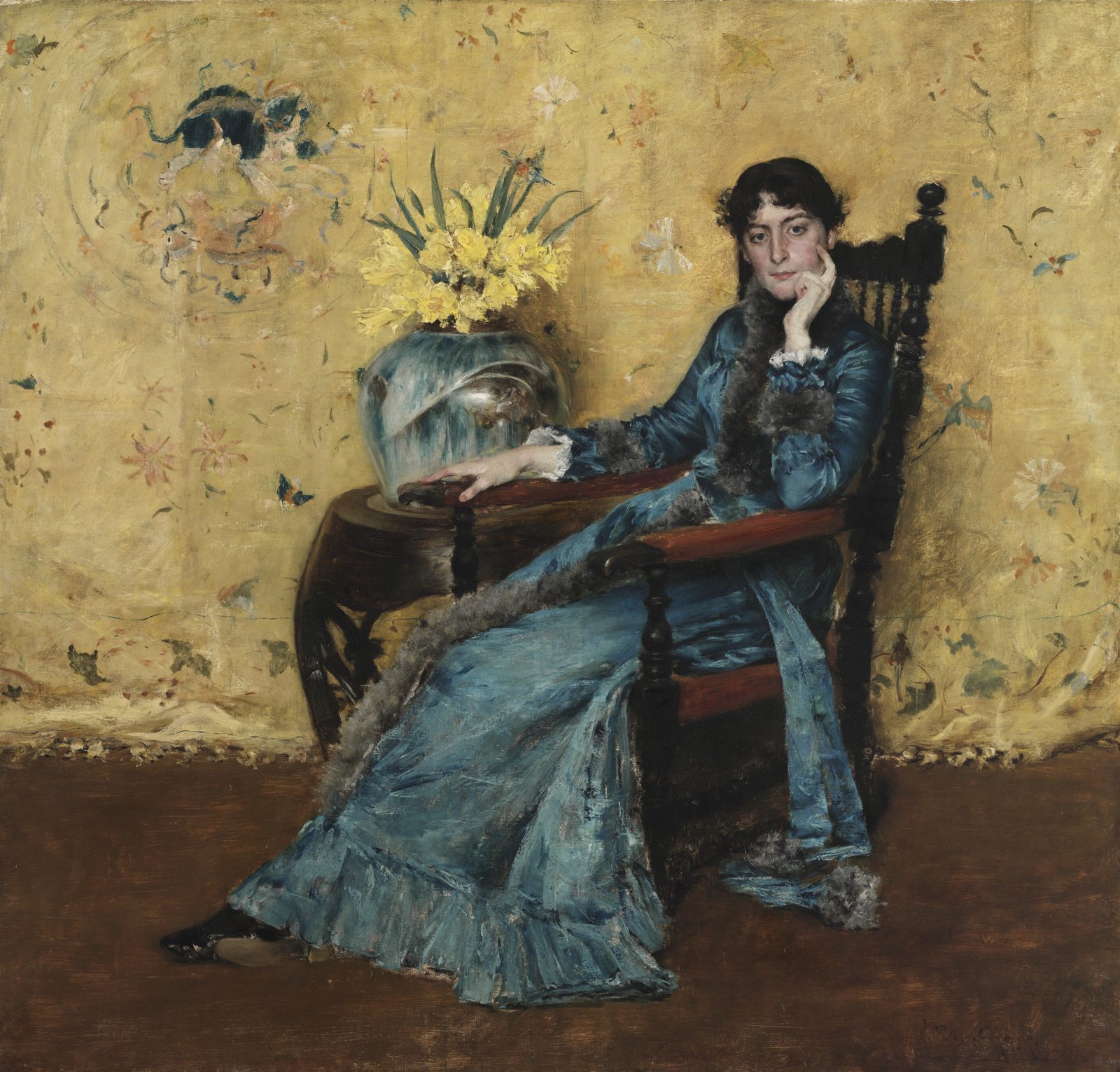
Dora Wheeler was a designer as well as William Merritt Chase's student. The rich textile behind her points to the professional world she helped build with her mother in a decorating business run by women. Chase's portrait won a gold medal in Munich in 1883, giving their artistic partnership an international stage.
The story
The yellow background occupies almost as much attention as the sitter. Flowers, birds, and curling forms spread across the fabric, while a blue vase and Wheeler's blue dress establish a second, cooler current of color. The setting is sumptuous, but it also has a professional meaning: Wheeler designed textiles. Chase surrounds her with something closely related to her own work.
Wheeler became Chase's first pupil after his return from study in Munich. Private instruction of this kind was far less accessible to women than to men. She subsequently joined her mother in a successful decorating enterprise operated entirely by women. The portrait therefore records more than a teacher's accomplished student. It presents a person whose artistic education helped lead into a working career.
Her pose complicates the formality of the full-length portrait. One hand supports her chin; the other rests beside the vase. Her dress sweeps toward the lower left, yet her gaze meets the space in front of her with a level, concentrated expression. The tall, dark chair provides a firm structure around that relaxed posture. Nothing in the painting requires us to invent her thoughts to recognize the balance between ease and alertness.
The painted surfaces offer their own conversation. The dress gathers into long folds, the flowers break into small yellow marks, and the background pattern stays comparatively flat. Chase makes these different textures legible without giving every part the same degree of finish. At the face and hands, the handling becomes more focused. Around them, decorative color has room to expand, making the figure feel both distinct from and at home in her surroundings.
The picture won a gold medal in Munich in 1883 and was also exhibited in Paris that year. Wheeler eventually owned it and gave it to Cleveland. That later history adds a quiet dimension to the scene: an image made by her former teacher, celebrated abroad, ultimately passed into public view through the sitter herself. The portrait preserves her presence alongside the materials of her vocation.
A closer look
Details worth noticing.
The embroidered background
The silk tapestry refers to Wheeler’s work as a textile designer. Its decorative presence gives the setting a professional meaning beyond the display of an elegant room.
Blue against gold
The cool blue dress and vase hold their own against the broad yellow background. Their repeated color connects Wheeler to the objects beside her without dissolving her silhouette.
The resting hand
The hand beneath Wheeler’s chin brings a small, informal gesture into a full-length portrait. Her upright gaze keeps the relaxed pose from becoming a picture of distraction.
Sources & image credits
Explore the museum’s research and collection record.
Gift of Mrs. Boudinot Keith in memory of Mr. and Mrs. J. H. Wade · CC0 · Original museum image