The story behind the painting · 3 min read
A Sunday on La Grande Jatte — 1884
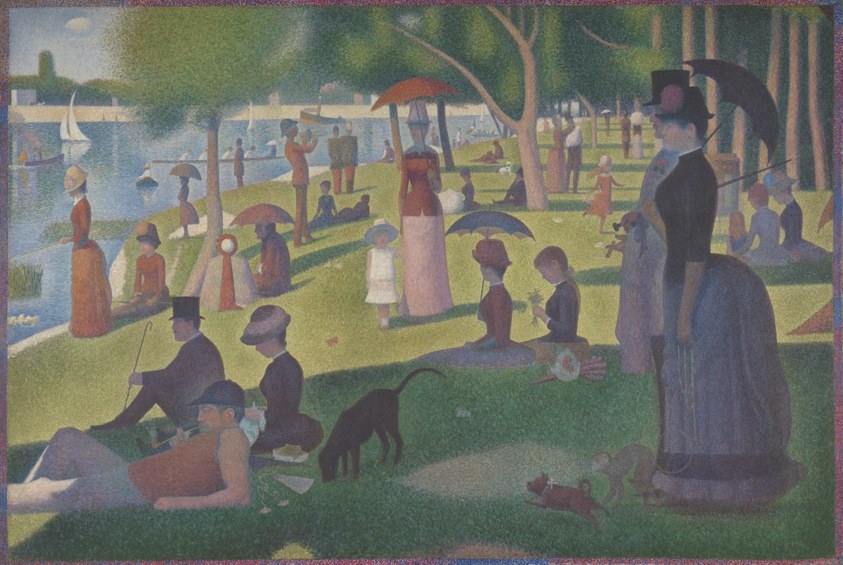
Georges Seurat turned a Parisian afternoon beside the Seine into a carefully constructed modern monument. The figures look almost motionless, but their surfaces flicker with small touches of color. Years of studies and revisions lie behind the scene, including the late addition of the monkey at the right.
The story
The park is crowded, but surprisingly quiet. People stand in profile, sit upright, or recline on the grass as though each has been assigned a place. The woman beneath a parasol at the right has the presence of a statue. Farther away, boats and tiny figures compress into the bright strip of river. Ordinary leisure has acquired an almost ceremonial stillness.
Seurat wanted a scene of modern life to carry the authority of an ancient Greek frieze. That ambition helps explain the measured spacing and firm silhouettes. These are Parisians spending time on La Grande Jatte, an island in the Seine, but the composition makes their separate activities feel like parts of one enormous arrangement. Its width, more than three meters, gives that arrangement a physical force that a small reproduction can conceal.
The image was built through numerous painted and drawn studies. Seurat also revised the large canvas, strengthening some outlines and inserting figures. The monkey on a leash was among those additions. What now looks like an inevitable part of the foreground was a decision made along the way, a reminder that this apparently frozen afternoon emerged through extended work rather than a single encounter outdoors.
Its stillness changes when you look at the paint. Small marks of different colors press against one another instead of disappearing into smoothly blended surfaces. A shadow is not simply a dark patch; it contains a lively field of touches. From a distance, those particles gather into dresses, grass, and water. At close range, the objects begin to break apart again. The painting continually asks the eye to alternate between the scene and its construction.
The foreground shadows make the sunlit middle ground seem especially luminous. Repeated parasols and upright tree trunks hold the crowded surface together, while the tiny central child faces outward more directly than many surrounding adults. That meeting of rigid order and restless color is the painting's enduring surprise: a bustling public space has become a deliberate, monumental pattern without losing the sparkle of an afternoon outside.
A closer look
Details worth noticing.
The added monkey
The monkey beside the foreground woman entered the composition during revision. Its curved tail interrupts the surrounding straight silhouettes, making this small late addition unusually conspicuous in the finished scene.
Color inside shadow
Look within the dark foreground grass rather than treating it as one flat shade. Separate colored marks keep the shadow active and help connect it to the brighter lawn beyond.
A child facing us
The small child in white near the center faces toward the viewer. Her bright dress and frontal position offer a brief direct encounter amid the surrounding profiles and turned bodies.
Sources & image credits
Explore the museum’s research and collection record.
- Art Institute of Chicago: collection record ↗
- Art Institute of Chicago: museum catalogue and open-access record ↗
Helen Birch Bartlett Memorial Collection · CC0 · Original museum image