The story behind the painting · 3 min read
Basket of Plums
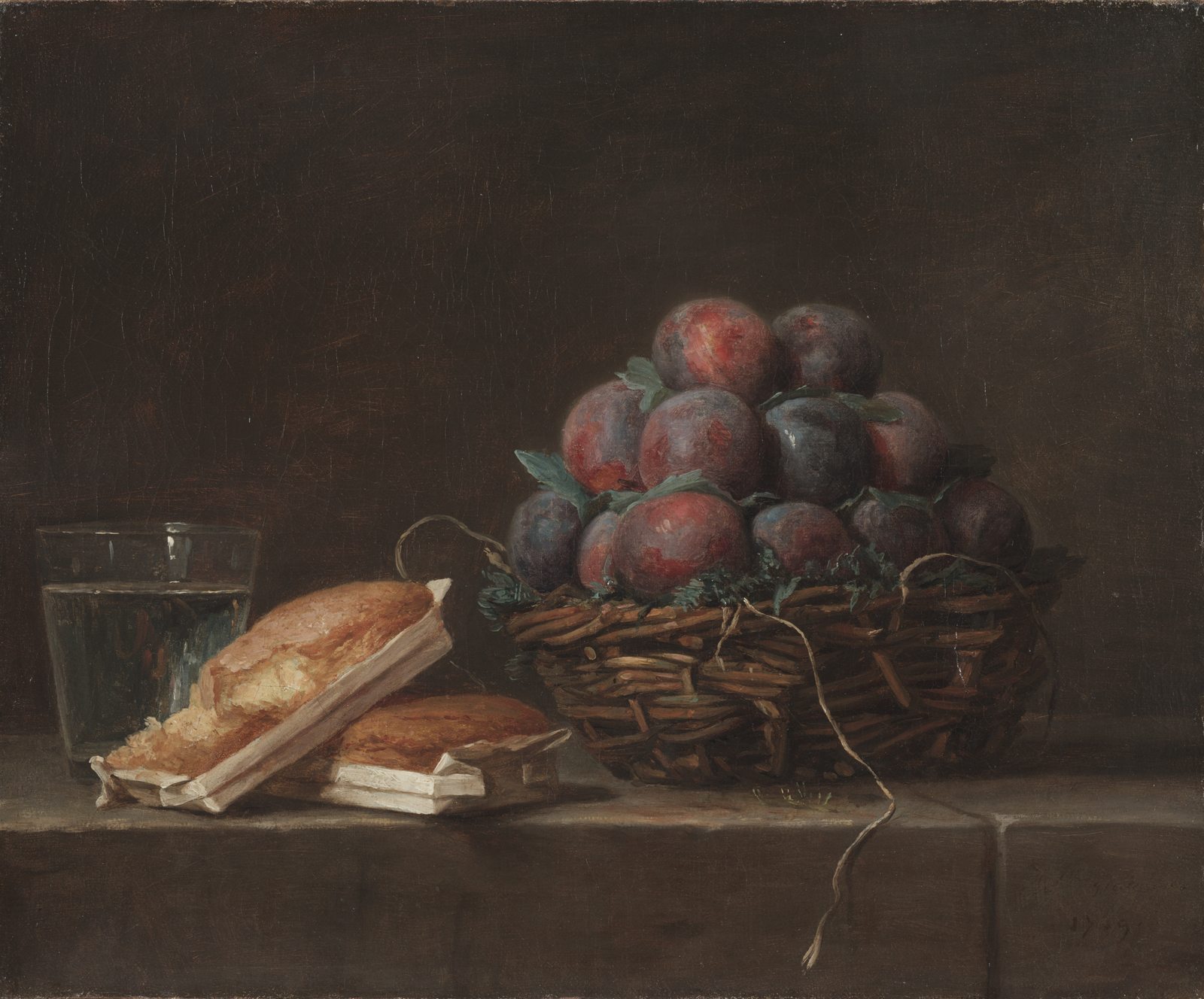
Anne Vallayer-Coster turns plums, cakes, and water into a study of surfaces: dusty fruit skins, woven fibers, crisp paper, and transparent glass. Fruit still lifes were popular in eighteenth-century France, but this modest arrangement rewards close attention. A broken cake and trailing strands beneath the basket make the objects feel recently handled rather than perfectly staged.
The story
A basket of plums rises out of darkness, its fruit piled into a loose pyramid. Beside it, cakes lie in pale wrappers and a glass holds water. There is no dramatic gesture or grand setting. Vallayer-Coster builds the painting's interest from differences that everyday attention might pass over: how a plum absorbs light, how paper catches it, and how glass almost disappears while remaining visible.
Fruit still lifes were popular in the later eighteenth century, and baskets of plums formed a familiar subject. Vallayer-Coster painted this one in 1769 and made a companion featuring peaches and cherries. Those facts place the work within a recognizable practice, but they do not make its arrangement routine. Each object occupies a distinct material and spatial role. The basket gives height and density; the cakes open a lighter area near the front; the water introduces transparency.
The plums are not uniformly purple. Red patches warm some skins while others fade toward blue or dark violet. Their softly powdered appearance contrasts with the basket's wiry structure. Individual strands catch light and cross one another, creating a network that feels both firm and irregular. The dark background strengthens these differences because it offers little competing information. Color and texture, rather than a described room, establish the scene's depth.
The cakes interrupt any impression of untouched abundance. One is broken, exposing its interior, and the wrappers bend at uneven angles. These small disruptions suggest handling without requiring an invented person or occasion. At the far left, highlights mark the rim and sides of the glass with very little paint. The clear vessel is convincing because its boundary is intermittent: we see the water and the surrounding darkness through it.
The ledge beneath the objects introduces another kind of solidity. Its front edge and visible joint give the arrangement a stable base, while loose strands trail beyond the basket and soften its order. The painting's quietness comes from this balance between careful placement and small irregularities. Its subject is ordinary food, but its lasting interest is the act of differentiation: one surface, weight, or edge made unmistakably different from the next.
A closer look
Details worth noticing.
The plum skins
Red, blue, and violet patches give the plums distinct surfaces rather than a single local color. Their soft bloom contrasts with the brighter, harder strands of the basket below.
The broken cake
The broken cake exposes a crumbly interior against smooth paper. This small interruption makes the arrangement feel handled and edible, rather than a collection of untouched, idealized shapes.
The water glass
A few pale edges and reflections establish the glass without filling in its whole shape. The dark background remains visible through it, making transparency part of the painting’s material variety.
Sources & image credits
Explore the museum’s research and collection record.
Mr. and Mrs. William H. Marlatt Fund · CC0 · Original museum image