The story behind the painting · 3 min read
A Woman Seated beside a Vase of Flowers (Madame Paul Valpinçon?)
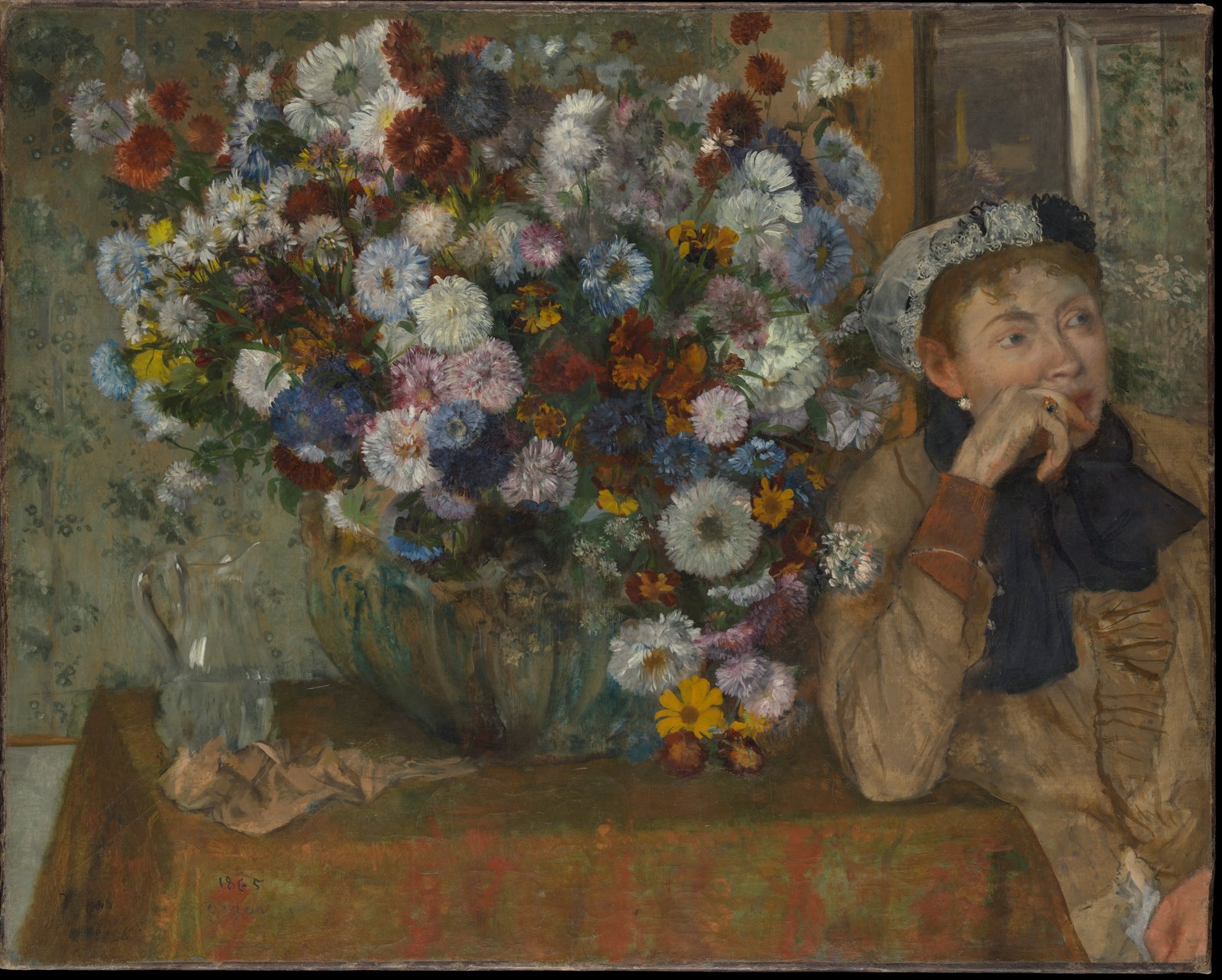
Degas gives the flowers the center of the canvas and pushes his sitter to the edge, making a carefully arranged picture feel casually encountered. The woman is probably Madame Paul Valpinçon, whose family he visited in the country. The late-summer bouquet turns a portrait into an unusual partnership between a person and a still life.
The story
The flowers take up the space where a portrait normally places its sitter. They spread across the center in white, red, blue, and yellow, while the woman is compressed against the right edge. Her hand rests near her mouth and her gaze travels beyond the frame. The arrangement feels momentary, as though our attention has arrived at the wrong place just as hers has departed. Yet the balance between bouquet and figure is too exact to be merely accidental.
Degas painted the canvas in 1865, probably depicting the wife of his friend Paul Valpinçon. He visited the family’s country house at Ménil-Hubert, and the flowers suggest a late-summer occasion. A preparatory pencil drawing of the woman from the same year survives. That preparation is a useful corrective to the idea that she was simply added after the still life: the effect of a casually glimpsed scene belongs to an artist who planned his pictures carefully.
The bouquet is exuberant but not shapeless. Light blossoms form a loose, uneven ring, while darker reds and greens gather inside it. Small yellow flowers near the table interrupt the larger mass and bring its color down toward the surface below. The rounded vase is partly swallowed by stems and shadow. Its muted blue-green curves have less immediate force than the petals above, helping the flowers appear to overflow rather than sit neatly contained.
The woman’s restricted space does not make her incidental. Her bent arm, dark neckwear, and turned head establish a second cluster of forms beside the bouquet, quieter in color but more suggestive of thought. The rectangular wall decoration behind her and the table edge below introduce straight lines into a scene dominated by rounded flowers and folds. These small adjustments keep the composition from tipping entirely toward the still life. Degas offers two different kinds of attention at once: the close inspection invited by flowers and the uncertainty of looking at another person who is absorbed elsewhere.
A closer look
Details worth noticing.
The crowded bouquet
Pale blossoms form an irregular ring around darker foliage and flowers. Their scattered brightness gives the bouquet a structure without making it symmetrical or reducing it to a single solid mass.
The averted face
The sitter looks beyond the frame with her hand near her mouth. That diverted attention makes a deliberately composed portrait feel like an encounter with someone occupied by another thought.
The low yellow flowers
Small yellow blooms drop toward the tabletop beneath the main bouquet. They connect its elevated mass to the lower surface and prevent the flowers from reading as one isolated circle.
Sources & image credits
Explore the museum’s research and collection record.
H. O. Havemeyer Collection, Bequest of Mrs. H. O. Havemeyer, 1929 · CC0 · Original museum image