The story behind the painting · 3 min read
Self-Portrait
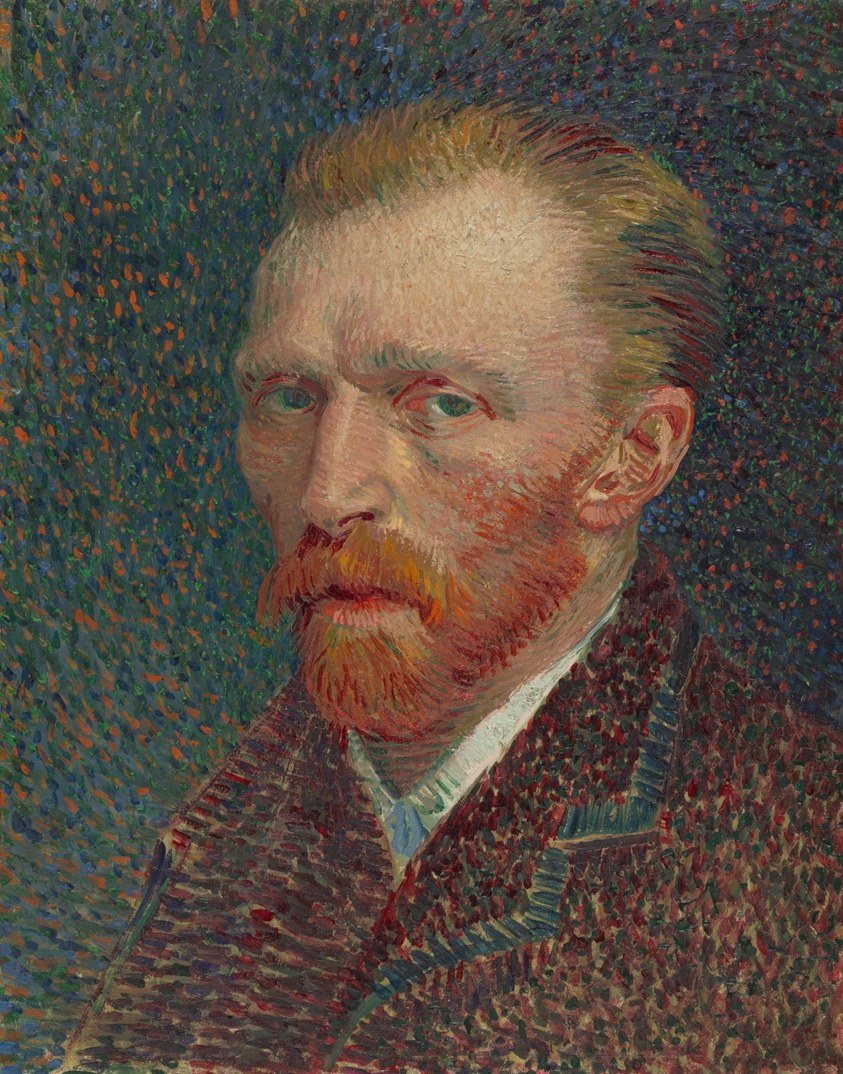
Van Gogh painted this small self-portrait during his Paris years, when new approaches to color were reshaping his work. Built on artist's board rather than canvas, the face and surrounding space are alive with distinct dabs. The influence of Seurat's pointillism becomes a highly personal method of describing a human presence.
The story
The face is steady, but the paint around it seems to move. Red and orange marks run through the beard, green strokes edge the eyes, and the dark jacket contains a dense scattering of contrasting colors. Even the background refuses to remain neutral. Van Gogh builds a portrait in which every surrounding area feels as actively worked as the sitter's features.
He arrived in Paris in 1886 and joined his brother Theo, an art dealer. During his two years in the city, he made at least twenty-four self-portraits. This one is a small work painted on prepared artist's board. Its modest support contrasts with the intensity of the surface, reminding us that an important experiment does not need a large canvas or an elaborate setting.
The densely separated marks reflect Van Gogh's encounter with Seurat's pointillist technique. Here, however, the marks change direction and character as they travel across different forms. Hair sweeps away from the forehead, the beard is articulated with longer strokes, and colored dabs cluster across the jacket. The result is less like a uniform screen laid over an image than a varied set of decisions about each part of the body.
The eyes are small but strongly held within the face. Reddish contours surround them, while cooler green notes appear within and nearby. A narrow white collar provides one of the clearest light shapes, separating the head from the patterned darkness below. The ear on the right is drawn with especially assertive curves. These accents give the viewer places to pause within the larger activity of the brushwork.
A self-portrait can tempt us to turn every stroke into a diagnosis or a confession. This painting offers something more securely visible: an artist examining what color can do to a familiar subject. The warm beard and cool surrounding field reinforce one another; the directional marks describe volume without concealing their individual existence. The likeness remains legible, but it also shows a method being tested. We see both a face and the labor of making paint stand for one.
A closer look
Details worth noticing.
Painted on board
The support is prepared artist’s board rather than canvas. The small scale makes the concentration of colored marks especially striking: this is an intimate object with an unusually active surface.
Color around the eyes
Green and reddish strokes meet around the eyes rather than resolving into a single flesh tone. Their contrast makes these small features hold attention within the busy painted face.
A jacket made of marks
The dark jacket contains many separate red, green, and blue touches. Follow their changes of direction to see how texture and the turn of the body emerge together.
Sources & image credits
Explore the museum’s research and collection record.
- Art Institute of Chicago: collection record ↗
- Art Institute of Chicago: museum catalogue and open-access record ↗
Joseph Winterbotham Collection · CC0 · Original museum image