The story behind the painting · 3 min read
The Gulf Stream
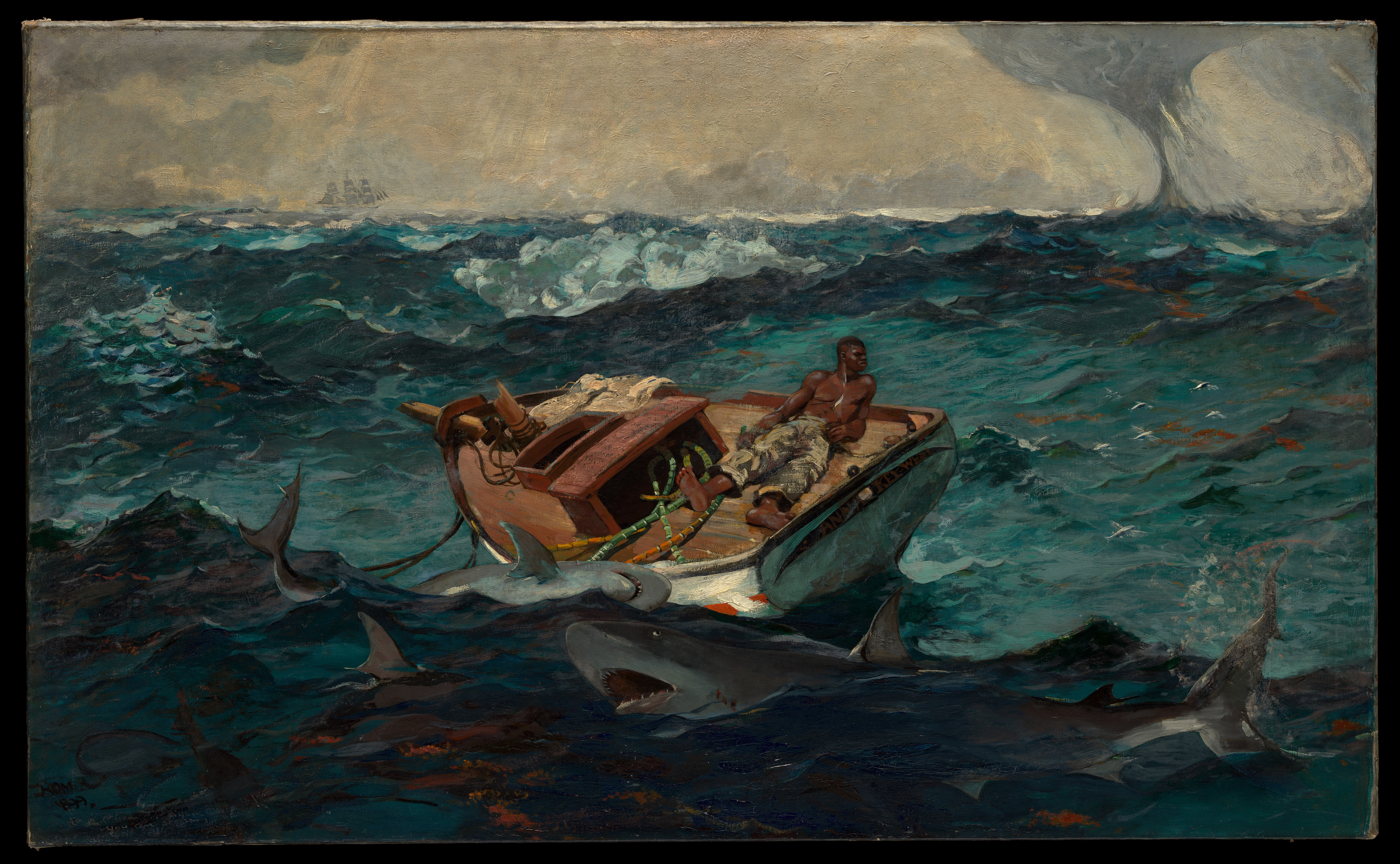
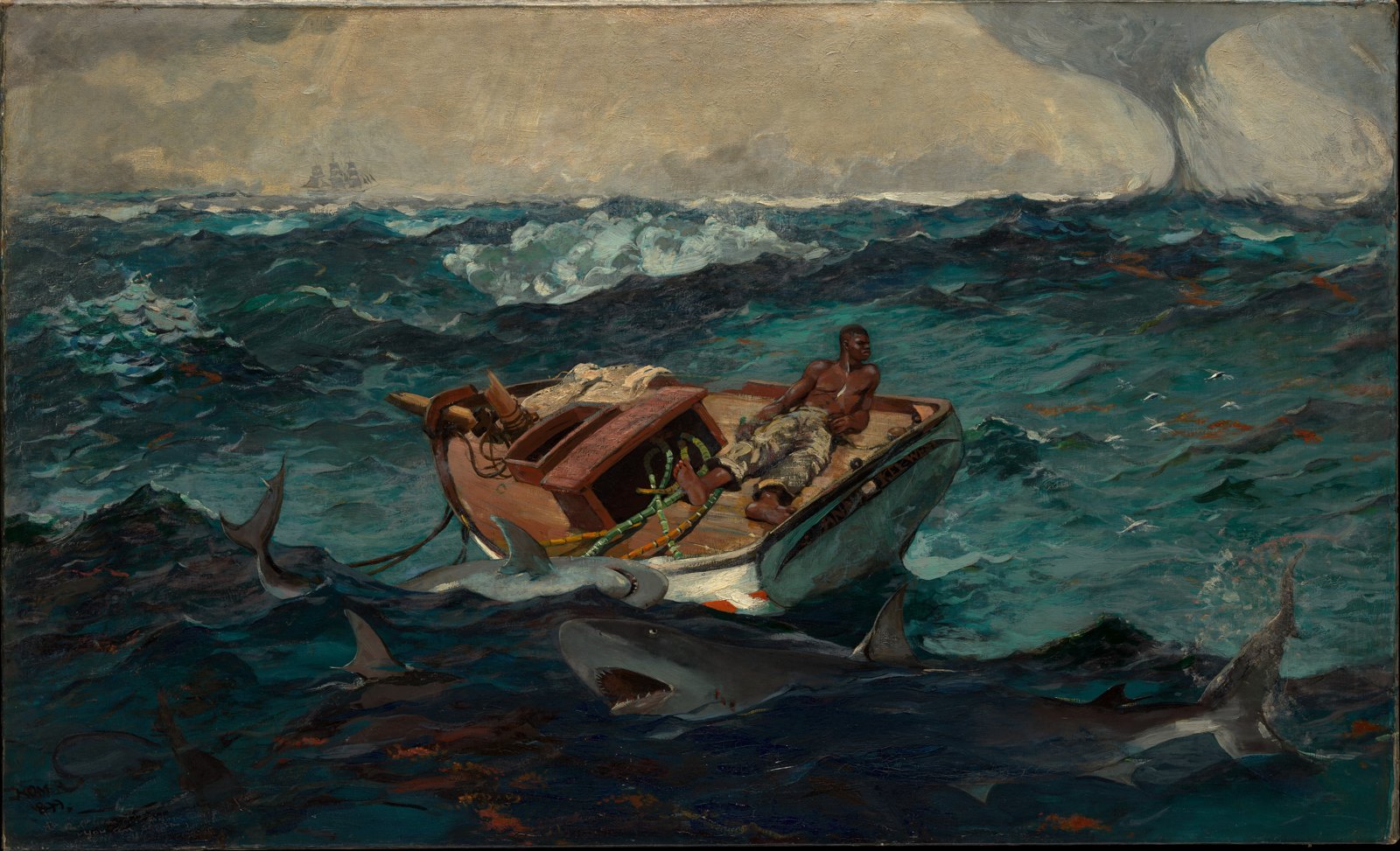
A damaged boat, circling sharks, and a distant waterspout surround a solitary Black man in Winslow Homer’s The Gulf Stream. Begun in 1899 and reworked by 1906, the painting connects danger at sea with Caribbean history through its sugarcane cargo. A distant ship offers possibility without resolving the survivor’s fate.
The story
The boat rises diagonally out of a trough, its broken mast and loose rigging making clear that its passenger cannot simply sail away. His body rests across the deck rather than reaching out in a theatrical appeal. Around him, water takes almost every imaginable form: a dark wall, a curling crest, a strip of foam, a hollow deep enough to hide a shark. The difference between the man’s relative stillness and the sea’s restless surface gives the painting its tension.
Homer began the canvas in 1899 and reworked it by 1906. The Gulf Stream of the title connects the Caribbean to the Atlantic world. Sugarcane aboard the vessel gives this confrontation with nature a historical dimension, recalling the plantation economy and the transatlantic system of slavery that supported it. The man is therefore more than a generic shipwreck victim. His isolation unfolds within a sea crossed by commerce, imperial power, and forced movement.
The threats occupy several distances. Sharks cut into the immediate foreground, their bodies almost continuous with the dark waves. Farther away, a waterspout descends from the sky at the right. On the opposite horizon, the small shape of a sailing ship opens the possibility of another human presence. Its size matters: it is visible enough to change the story, but too distant to promise rescue. Homer holds these elements in the same frame without converting uncertainty into a definite ending.
The palette makes that uncertainty physical. Blue-green water surrounds the warm brown boat and the man’s skin; thin pale edges of foam pick out the contours of danger. The boat’s exposed interior is lighter than much of the sea, which makes it look both vulnerable and distinct. The horizon gives the composition a steady boundary, but everything below it tilts and heaves. The painting’s power comes partly from this refusal to settle. A person remains present, composed, and particular inside conditions he cannot control, while the viewer can see dangers that offer no easy response.
A closer look
Details worth noticing.
The sugarcane cargo
Sugarcane in the damaged boat connects the scene to Caribbean plantation economies. This small cargo gives the maritime danger a historical setting shaped by commerce, empire, and slavery.
The distant ship
A tiny sailing ship appears on the left horizon. It introduces the possibility of help, but its remoteness prevents the painting from giving the stranded man a certain rescue.
The foreground sharks
The sharks share the water’s gray-green colors, making their bodies emerge gradually from the waves. Fins and pale mouths interrupt the surface close to the viewer rather than the horizon.
Sources & image credits
Explore the museum’s research and collection record.
Catharine Lorillard Wolfe Collection, Wolfe Fund, 1906 · CC0 · Original museum image