The story behind the painting · 3 min read
Cliff Walk at Pourville
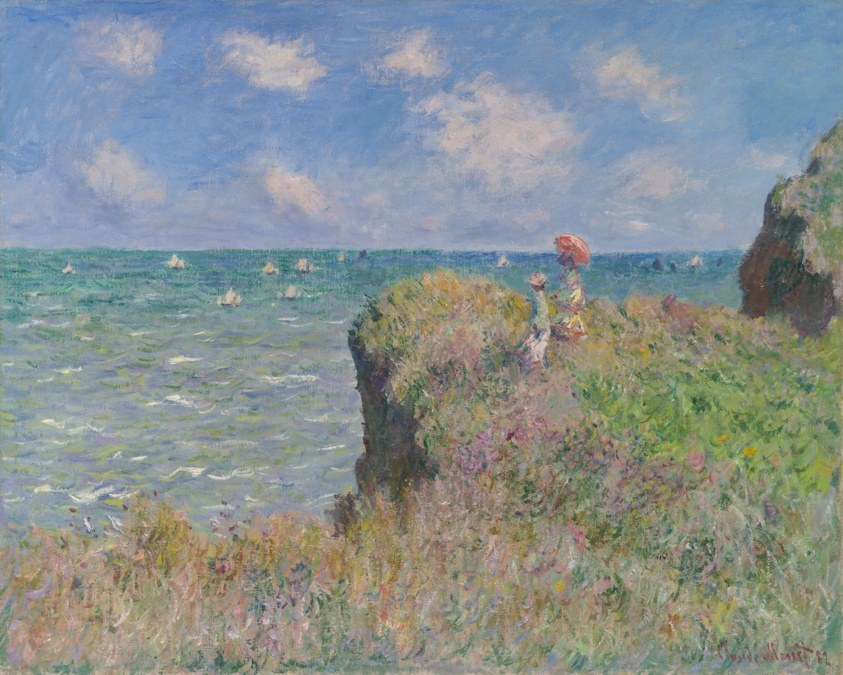
Monet found a productive retreat at Pourville on the Normandy coast in 1882. Two women, probably Marthe and Blanche Hoschedé, stand amid grass that seems to share the movement of their clothing and the sea. Beneath the lively surface, technical examination reveals that he revised the shape of the right-hand cliff.
The story
The cliff edge is startlingly close to the open sea. Grasses rise across the foreground in pink, green, and yellow strokes, almost hiding the path followed by two women. A parasol supplies a small warm accent against the blue distance. Nothing looks entirely still: the water, vegetation, clouds, and clothing all seem caught in the same changing air.
Monet went to Normandy in February 1882 and settled in Pourville after finding nearby Dieppe too urban. The fishing village offered subjects he wanted to paint during a period of personal and professional pressure. He remained there until the spring and returned in June with Alice Hoschedé and her children. The two women in this picture are probably her eldest daughters, Marthe and Blanche; the identification is likely rather than certain.
The figures are small enough to belong to the landscape without becoming its sole focus. Their pale clothing repeats colors found in the grasses and clouds. Their outlines are broken by the same restless marks that describe the hillside. Rather than cutting the people out sharply against a scenic backdrop, Monet makes them participants in its color and texture. The eye finds them gradually among the stems and flowers.
The sea has a different rhythm. Short horizontal strokes spread across its surface, and tiny sails give a measure of the enormous space beyond the cliff. The upright dark edge of the land interrupts that movement. Above, pale clouds open broad spaces in the blue sky. These shifts in direction and density allow a canvas full of distinct brushmarks to describe very different substances without smoothing the paint into invisibility.
The apparent immediacy also conceals revision. X-rays revealed that Monet reduced the rocky projection at the far right, adjusting the relationship between land, water, and sky. The composition was shaped as well as observed. That knowledge makes the airy result more impressive: the sense of a passing breeze depends on a deliberate balance of masses and intervals. The women can seem momentarily present on the cliff because the whole surrounding space has been so carefully organized.
A closer look
Details worth noticing.
Probable companions
The two walkers are probably Marthe and Blanche, Alice Hoschedé’s eldest daughters. Keeping that identification tentative preserves the distinction between what the museum can establish and what remains uncertain.
A revised headland
Technical examination found that Monet reduced the rocky projection on the right. The open relationship between sky and sea reflects a compositional adjustment beneath the seemingly spontaneous painted surface.
Brushwork in the grass
Pink and yellow strokes interrupt the greens of the foreground. Their varied directions prevent the hillside from becoming a solid mass and carry the sensation of movement up toward the walkers.
Sources & image credits
Explore the museum’s research and collection record.
- Art Institute of Chicago: collection record ↗
- Art Institute of Chicago: museum catalogue and open-access record ↗
Mr. and Mrs. Lewis Larned Coburn Memorial Collection · CC0 · Original museum image